


Qzino Review 2026: Is it legit? A valid Anjouan license, but three Qzino documents disagree
Qzino is a crypto casino and sportsbook on Anjouan license ALSI-202503015-FI1, and the license checks out at the regulator. You have to wager every crypto deposit in full before you withdraw. Wins are capped at $300,000 per bet, though the bonus hub advertises a $500,000 prize. Self-exclusion is by email only. Our real-money tests are coming soon.


- Any time, no threshold
- Not published
- Up to 7 days, or longer
- 9 territories
93.25% paid back
of the stake on 478,580 captured bets
Sep 16–23, 2026 · a feed ratio, not a game’s RTP
21 sections
Qzino FAQ: what people ask, answered up front
Is Qzino legit and safe?
Yes, Qzino is licensed. Anjouan license ALSI-202503015-FI1 showed as VALID for CG Universe Limitada at the regulator on Oct 4, 2026. Qzino prints two different registered addresses, and our withdrawal test is coming soon.
See the register entry →Who owns Qzino?
Qzino is run by CG Universe Limitada, Costa Rican company 3-102-919306, under Anjouan license ALSI-202503015-FI1. Its own documents call it “CG Universe”. No directors or beneficial owners are named.
See the operator record →Is Qzino available in the US, the UK or Australia?
No. All three are among the 9 countries Qzino blocks in Terms §3.5, and its license excludes them too. The list is open-ended (“including but not limited to”). This is Qzino’s list, not legal advice.
Open the Countries tab →Does Qzino require KYC?
Yes, whenever Qzino asks, and its Terms call the check mandatory for every user, whatever the homepage says about “anonymous play”. Terms §17.2 lets it restrict access, deposits and withdrawals until you’re verified. No approval time is published.
See the KYC rules →How fast are Qzino withdrawals?
Up to seven days “or longer if required” (Terms §9.1), whatever the homepage’s “Withdraw instantly” says. Some fiat payouts take up to seven business days (§9.12), and the clock starts only after the rollover. Our real-money tests are coming soon.
Open the Withdrawals tab →What does a Qzino level get you?
Qzino’s 8 tiers, from Bronze to Blue Diamond, pay cashback from “up to 4%” to “up to 40%” and rakeback from 10% to 15%. No WR is published for any of it, and cashback lapses if you don’t claim it before the next accrual.
See the levels chapter →What bonuses does Qzino advertise?
A deposit bonus of 200% to 370% on your first four deposits each month, paid into Q-Rake, which takes $500 of bets per $1 to unlock. The bonus hub adds a prize wheel “up to $500,000 in BTC”, above the $300,000 max win in Terms §9.6.
Open the Bonuses tab →What can you bet in on Qzino?
In the captured week, Qzino bets settled in 10 currencies, grouped into 3 families. Stablecoins carried 68.43% of bets and crypto 30.31%. That is what bets settled in, not a cashier list.
See the currency families →Does the data show Qzino’s RTP?
No. The feed shows a payout ratio of 93.25% across 478,580 settled bets, which is not a game’s RTP. It isn’t a house edge or a forecast either.
See how the ratio moves →The feed paid back less than it took. Is that Qzino’s house edge?
No. 93.25% describes the bets this feed chose to show, not the games. The 100 bets with the largest payouts returned $199.6K, 33.21% of everything the feed paid back all week.
See how the ratio moves →Are Qzino’s games provably fair?
Qzino says its single-player Originals run on HMAC-SHA256 seeds you can check in Game History. We haven’t verified a bet. A hash showed up on 100.00% of captured bets, which only means the payload carried one, not “verified fair”.
See proof-field coverage →Is everything on Qzino its own games?
No. Qzino’s documentation lists slots, live casino and a sportsbook. But all 478,580 bets in our capture came from its 7 in-house games, with no slot, live table or sports market in the feed.
See the games chapter →How many Qzino players are in the data?
A public feed can’t tell you, because it shows account keys, not people. The capture has 1,470 keys with 1,533 public display labels, and one person can hold several keys.
See the concentration figure →How do I complain to Qzino if something goes wrong?
Email support@qzino.com from your registered address within 14 days of the bet or transaction. A later claim “will not be reviewed or processed” (Terms §22.2). Qzino aims to reply within 28 calendar days.
See the complaint route →What is still not checked in this Qzino review?
Three things. We haven’t pulled the Costa Rican company record, and Qzino publishes no coin list, minimum or fee outside the logged-in cashier. Our real-money tests are coming soon, so every rule here is published, not measured.
See what is still open →Can the numbers on this page be reproduced?
Yes. Every figure comes from a committed snapshot rebuilt from the collector database. It covers a 168-hour window anchored to collection time, with 478,580 bets and 478,580 unique source bet IDs.
See the capture quality →
Qzino at a glance
CG Universe Limitada, Costa Rican company 3-102-919306, runs Qzino under Anjouan license ALSI-202503015-FI1. The regulator’s register and the certificate in Qzino’s footer both list the license as VALID. Qzino and its certificate print two different registered addresses.
Qzino’s cashier rules are strict. You wager 100% of every crypto deposit (200% for fiat) before you withdraw, and the payout goes back to the same wallet. Processing “can take up to seven (7) days or longer”, and Qzino publishes no coin list, minimum or fee figure.
Every responsible gambling tool is an email to support. Qzino names none of the four ADR providers its license requires.
Qzino’s public bet feed showed 478,580 bets, all on its 7 in-house games. Just 100 of them took 33.21% of everything the feed paid back.
- Offshore Finance Authority of the State of Anjouan
- ALSI-202503015-FI1
- CG Universe
- 9 territories
- Oct 4, 2026
- 478,580
- Sep 16–23, 2026
- 168 hours
- +2
Qzino screenshots: the logged-out lobby on desktop and mobile
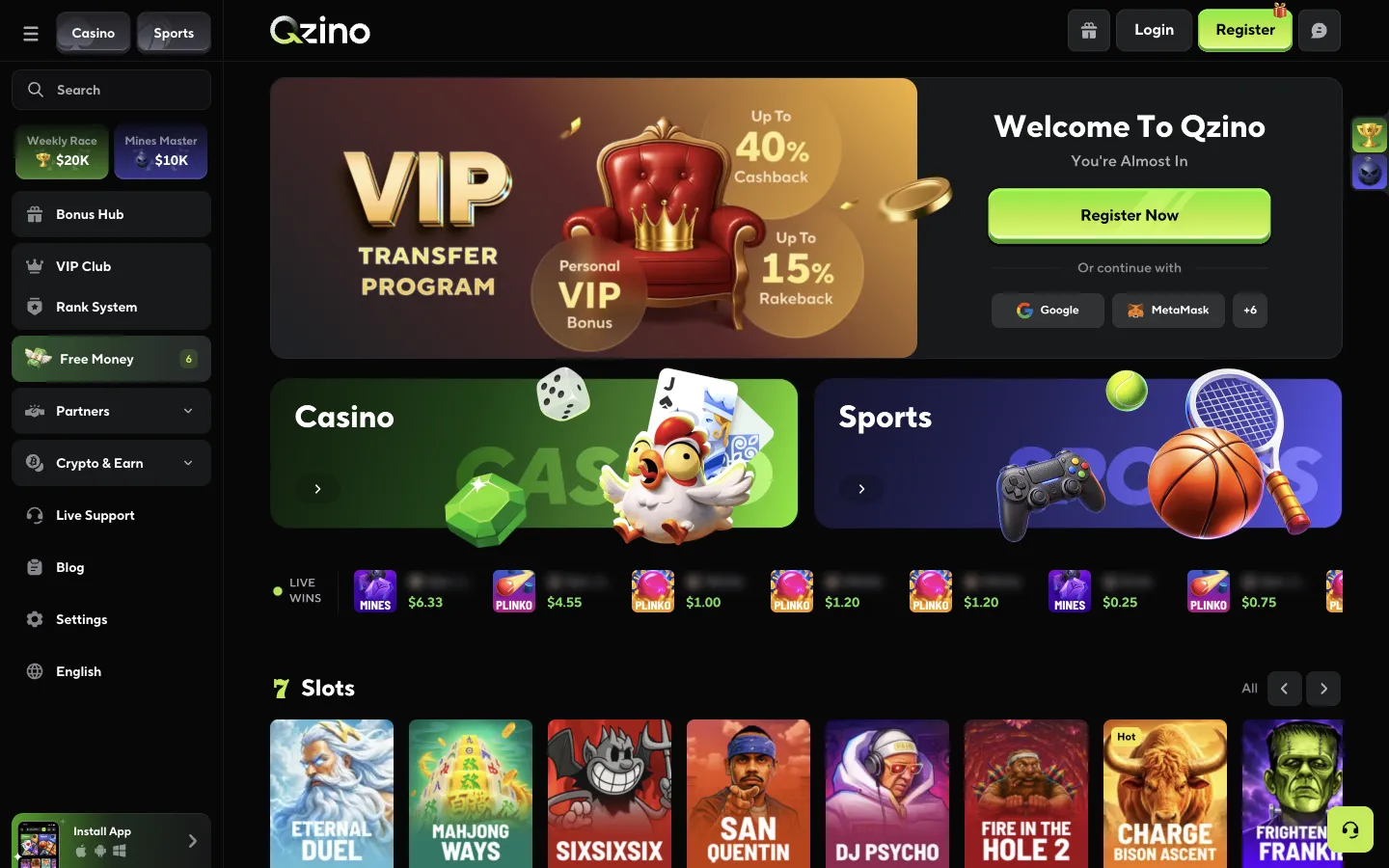
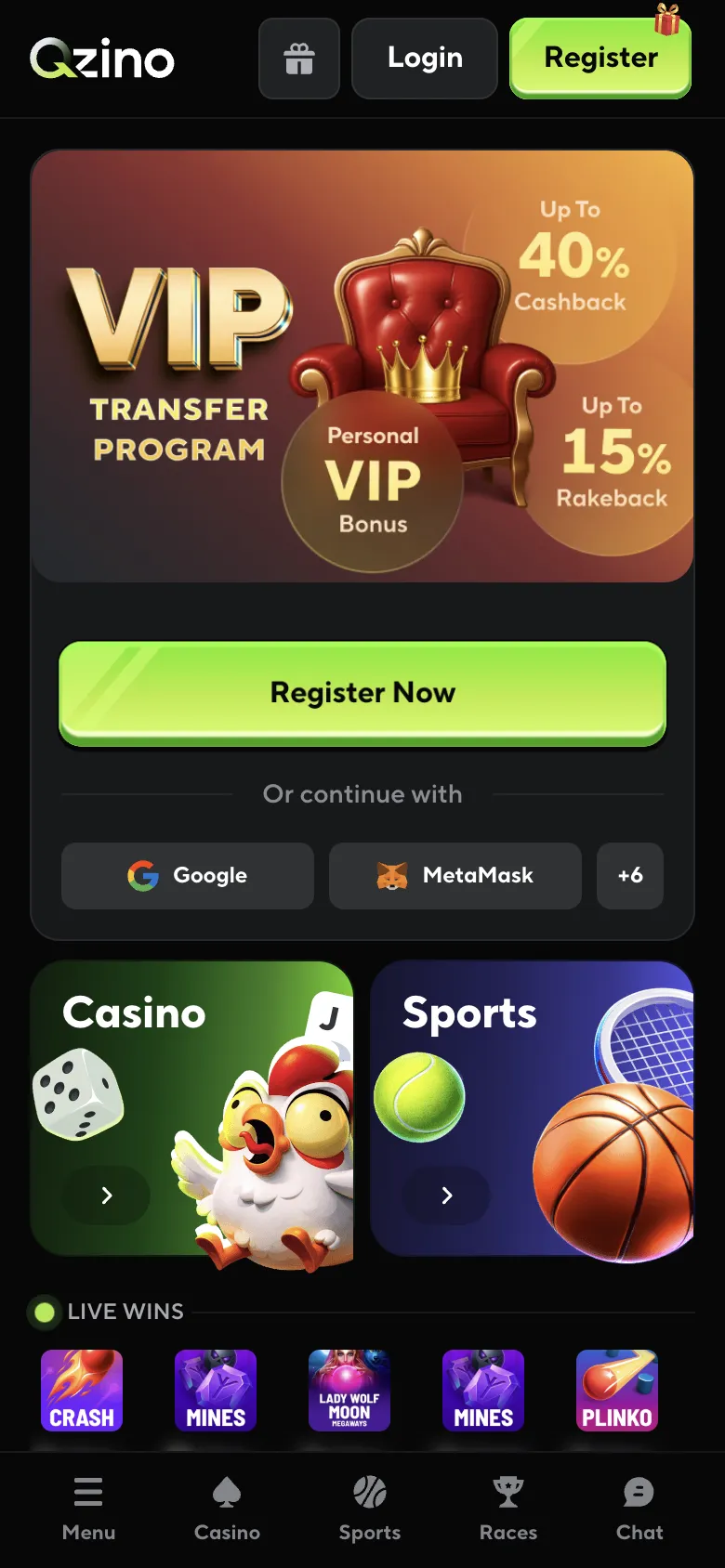
qzino.com, logged out, Oct 3, 2026. Player names in the live wins strip are blurred.
Qzino pros and cons
Pros
- License ALSI-202503015-FI1 listed as VALID in the Anjouan register and on its certificate
- All 8 rank tiers published, with cashback and rakeback for each
- No deposit fee, and Qzino says it usually absorbs the transaction fee
- Every captured bet carries a dollar stake and payout
- A written complaint route: support, senior management, then the Anjouan regulator
- A rank never drops once unlocked
Cons
- Three Qzino documents disagree: two addresses, two self-exclusion timings, a $500,000 prize over a $300,000 cap
- Every responsible gambling tool is an email to support, and chat requests are refused
- Names none of the four approved ADR providers its license requires
- No coin list, minimum or fee published outside the logged-in cashier
- Claims must reach Qzino within 14 days, and bet history is kept for 30 days
- Every deposit needs wagering before a withdrawal, 100% for crypto and 200% for fiat
What to check before you deposit at Qzino
1Who runs Qzino, and under what license?
ALSI-202503015-FI1
CG Universe Limitada, Costa Rican company 3-102-919306. The license is listed as valid in the Anjouan register and on the certificate in Qzino’s footer. Qzino and the certificate print different registered addresses.
See the evidence →Trust the license, and treat the company details as unconfirmed until the Costa Rican register is checked.
2Does Qzino accept players where you live?
9 countries blocked
Terms §3.5 names Australia, Austria, Comoros, France, Germany, Netherlands, Spain, United Kingdom and USA, two more than the license excludes. The list is open-ended (“including but not limited to”). The regulator won’t hear complaints from its own excluded territories.
See the evidence →Check both lists and your local law before you sign up.
3What do the Qzino bet figures cover?
7 in-house games
Every captured bet carries a dollar stake and payout, so the figures cover 100.00% of the capture. The feed has no slot, live table, sportsbook, deposit, withdrawal, balance or bonus rows.
See the evidence →Read every dollar figure as settled bets on Qzino’s own games, nothing else.
4What does the public feed pay back?
93.25%
That is across 478,580 settled bets. Take out the 100 largest payouts and it drops to 71.78%. Both figures come from the same bets, and both are below break-even.
See the evidence →Read it as a fact about the feed, not a game’s RTP or what the casino pays.
How we checked Qzino
These are the checks behind this review, each with its date. The numbers come from Qzino’s public bet feed and the rules from its own documents. Our method
- License checked at the regulator
Two regulator surfaces return the license, but they list different numbers of domains. Qzino’s footer also claims a compliance verdict the register doesn’t make.
- Operator documents read
12 documents from Qzino’s terms, help center and policies, each one linked under Sources.
- Public bet feed captured
478,580 bets over 168 hours, Sep 16–23, 2026. Source: Originals feed · USD stake and payout.
Coming soon
We haven’t deposited at Qzino yet. Each result will land here with its date and how long it took.
- Deposit
How long a crypto deposit takes to credit, on two networks.
- Withdrawal
How long a withdrawal takes to reach our wallet, and every fee on the way.
- Support chat
How fast a human replies in live chat, and whether the answer matches the terms.
- KYC check
What the casino asks for, when it asks, and how long approval takes.
Qzino score: 7.8 out of 10
- License8.3Answered: how the license was checked, license number match, issue and expiry dates and licensing authority. Conflicting or only pointed at: license holder and licensed domains.
- Withdrawals4.5Answered: processing time, withdrawal limit and deposit playthrough. Not published: withdrawal fee, confirmations, minimum withdrawal, withdrawal coins and payout networks.
- KYC10.0Answered: what the terms require, when KYC is triggered, accepted documents, limits during a check, verification time and if you don’t verify.
- Complaints & self-exclusion8.1Answered: where a complaint starts, escalation route, complaint deadlines and what the regulator says. Conflicting or only pointed at: self-exclusion. Not published: named ADR body.
- Restricted countries7.3Answered: restricted countries, whether the list is complete, what the license covers, game provider blocks, what happens to the account and how location is checked. Not published: second list and using a VPN.
- Bonus terms8.6Answered: bonus offer, wagering requirement, bonus expiry, rakeback or reward rate, game contribution and forfeiture rules. Conflicting or only pointed at: max cashout. Not published: max bet while wagering.
- Public bet feed10.0The feed shows losing bets as well as wins, in dollars, so its totals can be checked.
Qzino restricted countries: where can’t you play?
Two listsQzino blocks 9 countries by name (Terms §3.5) and leaves the list open with “including but not limited to”. Its Anjouan license excludes a shorter list of seven. Austria and Germany appear only in Qzino’s Terms, and neither document says why.
The list is open-ended, so a country missing from both lists isn’t a green light. This is Qzino’s list, not legal advice. Read the Terms and Conditions (PDF)
Anjouan license exclusions and complaints
If you play from one of the license’s seven excluded territories, the Anjouan regulator won’t hear your complaint. Its certificate says such complaints “will not be entertained”.
Why Comoros is on Qzino’s list
Comoros is on Qzino’s own list, because an offshore licensee generally can’t serve the place that licensed it.
- 9 countries
- 7 territories
- Where the license doesn’t reach. The regulator won’t hear complaints from there.
- Open-ended
- Plus sanctioned and FATF-blacklisted countries, and any the regulator or Qzino bars.
Restricted countries list
Qzino doesn’t accept players from these 9 territories.
- Australia
- Austria
- Comoros
- France
- Germany
- Netherlands
- Spain
- United Kingdom
- USA
Who owns Qzino, and is its license real?
License verifiedCG Universe Limitada, Costa Rican company 3-102-919306, holds Anjouan license ALSI-202503015-FI1. Both the regulator’s public register and the certificate in Qzino’s footer show it as VALID. Open the register entry
Qzino’s two addresses and two company names
Qzino and its own certificate print different registered addresses. Both are in San Pedro, San José, but they are not the same building, and no Qzino document mentions the second one. Qzino writes “CG Universe”, while the register and the certificate write “CG Universe Limitada”.
Qzino’s footer compliance claim
Qzino has passed all regulatory compliance and is legally authorized to conduct gaming operations for any and all games of chance and wagering.
No register says Qzino “has passed all regulatory compliance”, and we haven’t verified it. A VALID license leaves these questions open:
- The two registered addresses
- The company record behind 3-102-919306, which we haven’t pulled yet
- The ADR provider Qzino doesn’t name
- The territories the regulator won’t hear
- ALSI-202503015-FI1
- B2C, valid on the Anjouan public register
- Issued March 18, 2025, expires March 17, 2027
- qzino.com, qzino.io
- The certificate names only qzino.com
- VALID, generated Oct 4, 2026
- CG Universe
- Registered as CG Universe Limitada with the regulator
- 3-102-919306
- Costa Rica. Not pulled from the national register.
- Not found
- Not found
- San Jose, Montes de Oca San Pedro Los Yoses, eighth and tenth avenue, thirty-nine street, LY Center
- Ofident Building, Office 3 Costa Rican North American Cultural Center, 200M North and 50M East, San Pedro, San Jose 11501, Costa Rica
License
- Offshore Finance Authority of the State of Anjouan
- ALSI-202503015-FI1
- CG Universe
- Checked at regulator
Qzino KYC: when can Qzino ask you for ID?
Any timeQzino can ask you for KYC at any time, with no published threshold (Terms §17.2). It gives itself up to 7 days for its first reply. You then have 30 days from its first email (from risk@qzino.com) to finish.
Until you pass, Qzino can restrict access, deposits and withdrawals. Miss the window or refuse, and it can suspend or close the account for good.
Qzino’s “anonymous play” claim
Qzino’s homepage description sells “anonymous play”. Its Terms call CDD on request “mandatory for all Qzino platform users”, and a check can ask for ID, a selfie, your occupation and your source of funds (Terms §17.1.4, §17.2.1). The Terms bind you, not the description.
Qzino KYC approval time
Your 30-day clock is fixed, but Qzino sets no time within which it must finish a check. Our KYC test is coming soon.
Underage accounts at Qzino
If a player turns out to be underage, all winnings are withheld and repayable on demand. Deposits that aren’t winnings are returned, or held until the player turns 18, at Qzino’s discretion, minus payment fees (Terms §16.1).
- 18, or higher where the law says
- Proof of age can be requested any time (Terms §3.3).
- Email, confirmed within 30 days
- Anything, any time
- No amount or activity threshold (Terms §17.2)
- “anonymous play”
- Against Terms §17.1.4, which makes CDD on request mandatory
- ID and a selfie
- Terms §5.2 also asks for a photo ID and a recent utility bill.
- Funds can be frozen
- Until their origin is confirmed (Terms §17.2.1, §17.1.2)
- 7 days for Qzino, 30 for you
- Miss yours and the account can be closed (Terms §17.2).
- Deposits, withdrawals restricted
- Wagering can be suspended too (Terms §5.2). No completion time.
Qzino withdrawals: what has to happen before you cash out?
100% rolloverBefore a Qzino withdrawal, you have to wager 100% of every crypto deposit (200% for fiat), unless you’re Level 30 or higher. That was Level 15 until the Terms of September 23, 2026. Payouts go back to the wallet the deposit came from, and single wins are capped at $300,000.
Qzino’s homepage description says “Withdraw instantly”. Its Terms give a processing window of up to seven days, “or longer if required”, and that’s the figure a dispute would turn on.
An account frozen for inactivity can be charged 50 USDT a month. Qzino publishes no coin list, minimum or fee figure, because the cashier sits behind the login.
Qzino’s AML deposit rollover
Qzino calls this deposit rule an anti-money-laundering rollover, so it applies to a plain deposit with no bonus attached. No game weighting is published, so you can’t tell whether a low-edge game clears it as fast as a slot. A withdrawal passes four gates, in this order:
- The deposit rollover
- The same-wallet rule
- The $300,000 max win
- The processing window, “up to seven (7) days or longer” (Terms §9.1)
Our real-money tests are coming soon. Read the Terms and Conditions (PDF)
Qzino bet history: 30 days
Qzino keeps bet history for 30 days at most (Terms §6.12). If you might dispute something later, save your own export.
Qzino currencies in the bet feed
Bets in the feed settled in 10 currencies, grouped into 3 families. Stablecoins carried 68.43% of bets and the crypto family 30.31%.
These are the coins bets settled in, not a cashier list. The feed has no deposit, withdrawal, balance or bonus rows.
- 100% crypto · 200% fiat
- Waived from Level 30 (Level 15 until September 23, 2026). No game weighting published.
- Up to 7 days, or longer
- Terms §9.1. Some fiat up to seven business days (§9.12).
- $300,000 per bet
- Paid in equal installments over up to 90 days (Terms §9.6).
- Not published
- Terms §9.4 lets Qzino change it any time without notice.
- None
- Qzino says it usually absorbs the transaction fee. You pay wallet or network fees.
- Exists, not published
- Deposit less and it “may result in the loss of funds” (Terms §8.1).
- None
- Terms §8.1
- Coming soon
Bets, account keys and USD results by currency family
Every bet falls in one of three families. The fiat family merges labels for privacy and is not a market list. Where a USDT bet lacked a normalized amount, its raw amount and payout fill in under a documented repair that fails closed.
Qzino levels, rakeback, VIP and bonuses: what is a level worth?
Ladder published, prize cappedQzino’s rank ladder pays cashback from 4% to 40% and rakeback from 10% to 15%, across eight tiers from $1K to $2.77B. VIP starts at rank 30 and SVIP at rank 57.
Qzino’s deposit bonus pays 200% to 370% on your first four deposits each month, into a Q-Rake balance that unlocks at 1% × 20% of every bet. So each $1 of bonus takes $500 of wagering. Those rules sit on Qzino’s docs site, not in its Terms or on the bonus hub. The bonus hub advertises a $500,000 wheel prize, but Terms §9.6 caps any win at $300,000.
Qzino deposit bonus and Q-Rake
The minimum deposit rises with each bonus, from $5 for the 200% to $200 for the 370%, and the bonus caps run from $25,000 to $100,000. Only Originals, slots and live casino bets unlock Q-Rake. What unlocks becomes claimable at 00:00 UTC the next day, and anything you don’t claim within 24 hours is voided. No maximum bet is published. Read the Q-Rake page
Qzino rank tiers and thresholds
You start at Rank 0 (NEWCOMER) and climb eight tiers. The dollar row in the ladder has no unit and no explanation. Next to the line “It goes up according to the wagered amount while playing on Qzino”, it almost certainly means total wagering, but Qzino never says so. See the rank system page
Qzino wheel prize and the $300,000 max win
The bonus hub offers a wheel “up to $500,000 in BTC”. The VIP page splits it into a Gold Wheel “up to $300k in BTC” and a Diamond Wheel “up to $500K”. Terms §9.6 caps any bet, spin, bonus round or free spin at $300,000, and no Qzino page reconciles the two.
When Qzino pays cashback and rakeback
Qzino pays cashback twice a week and rakeback every 30 minutes. Weekly and monthly bonuses are described only as “based on your activity”. Its docs add that cashback, up to 40% of net losses by rank, counts Originals and slots and expires if you don’t claim it before the next accrual.
Qzino levels in the bet feed
The feed stamps a level on 100.00% of captured bets. Each account counts once, at its latest level. A level is what the feed printed beside a bet, not a verified VIP tier.
Which Qzino levels bet the most
The 30+ band placed 58.23% of captured bets and 51.89% of stake, $334.6K from 416 account keys. Money and bet count peak in the same band. 191 keys changed level during the window, so the bands show where accounts ended up, not their history.
- Twice a week
- Every 30 minutes
- Can be multiplied with a rakeback boost
- No formula published
- Both described only as “based on your activity”
- Up to 20% cashback, twice a week
- Sports rakeback every 30 minutes, win or lose
- VIP from rank 30, SVIP from 57
- 200% to 370% on four deposits
- A month, from a $5 to a $200 minimum deposit, into Q-Rake
- About 500x, via Q-Rake
- Each bet unlocks 1% × 20% of its stake. Originals, slots and live casino count.
Qzino’s published rank ladder
Qzino games: what gets played most?
From the feedQzino’s 7 in-house games carried all 478,580 captured bets. 4 paid back less than they took over the week, and 3 paid back more. No studio game, live table or sports market shows up in the feed.
Qzino game payout ratios
Each game’s ratio rides on the same handful of huge payouts as the headline figure. The snapshot doesn’t split that top cohort by game. Read the table next to the cut ladder in the bet data chapter, and don’t pin the biggest wins on any one game.
Qzino slots, live casino and sportsbook
Qzino’s documentation lists slots, live casino and a sportsbook next to its in-house games. Its site lists the same seven in-house games the feed contains. Not one captured bet came from a slot, a live table or a sports market, so our bet figures cover the in-house games only. Qzino documentation · Qzino Originals
Qzino Originals RTP and Provably Fair
On September 18, 2026, Qzino raised the declared RTP of its Originals from 98% to 99% in Coin Flip, Dice, Dice Ultimate, Limbo and Crash, which halves the house edge to 1%. Its fairness page says the single-player Originals use HMAC-SHA256 with a hidden server seed, your client seed and a nonce, and you verify a bet in Game History after rotating your seed pair. Read the fairness page
Qzino hash and seed fields
100.00% of captured bets carried a hash and 100.00% a random seed. That only means those fields had values.
The feed shows no pre-bet server seed commitment and no client seed or nonce rules. No raw hash or seed is exported, and no bet has been reproduced, so nothing here says “verified fair”.
- 100.00%
- 478,580 bets
- 100.00%
- 478,580 bets
- 99.44%
- 475,921 bets
- 100.00%
- Of eligible Plinko bets, not the whole capture
Every Qzino game in the capture: bets, account keys, USD results and win rate
Keno arrives without the type field the other six games carry, so it stays in the ledger labeled as a legacy envelope. A win means a payout above the stake, so a losing bet may still have returned part of it. Single-bet extremes (largest bet, largest payout, highest multiple) are withheld for every game, since one next to these totals would expose a single bet.



What responsible gambling tools does Qzino offer?
Email only, policy disagreesQzino offers limits, a session alert and self-exclusion, but only by email to support. You can’t set any of them yourself, and chat requests are refused. Its policy gives two answers on when an exclusion starts, and one paragraph both requires and forbids moving your balance.
Qzino self-exclusion by email only
As for now all of these tools are available only through the request to the support@qzino.com.
Self-exclusion or account closure requests sent through chat “will not be processed”, and only email counts. Read the Responsible Gambling Policy (PDF)
When Qzino self-exclusion starts
Qzino gives two answers. The Responsible Gambling Policy says it starts when you receive the confirmation email. Terms §6.8 says within 24 hours. The exclusion is irreversible, and you can’t reverse, shorten or cancel it for any reason, so the gap matters.
Withdraw before you self-exclude at Qzino
The policy says you can’t leave funds in an excluded account. In the same paragraph, it says you can’t get into the account to withdraw them. It gives no way to do it in the other order, so withdraw first.
During the self-exclusion period, you are not permitted to leave any funds in your account. You will not be able to access your account to deposit, wager, or withdraw any funds until the self-exclusion period has ended.
Anjouan’s self-exclusion form
Qzino’s license seal page also carries the regulator’s own self-exclusion form, with set periods. You can pick a 2-day or 1-week cool-off, 1 to 6 months, 1 year or permanent. Anjouan shares that list only with operators on its platform. Open the regulator’s self-exclusion form
What the Anjouan license requires
The Operator must adhere to international Anti-Money Laundering (AML) protocols and provide functional Responsible Gaming (RG) tools, including self-exclusion and deposit limit capabilities.
Qzino’s policy makes every one of those tools an email to support. Whether that meets the license condition is for the regulator to decide. See the license certificate
A newer Qzino Terms version you won’t find linked
A Terms PDF dated 28.09.2026 sits at Qzino’s old Terms address, and no Qzino page links it. Its new §3.18 makes you tell support about any gambling addiction or self-exclusion registry you’re on, at or before sign-up. If you don’t, you “unconditionally forfeit any right to demand or receive a refund for any deposits, wagers, or losses incurred”. The footer still links the 23.09.2026 version. Open the 28.09.2026 PDF
How concentrated Qzino’s betting is
Just 100 account keys placed 81.63% of all captured stake. That is 6.80% of the 1,470 keys in the capture, ranked by USD stake.
A key is a stable source ID, not a verified person, and one person can hold several. The 1,533 public labels across these keys changed 42 times during the window.
- From the confirmation email
- The email states the dates, and the account closes within 24 hours.
- Within 24 hours
- The account is disabled until further notice.
- A chosen period or permanent
- No list of lengths published. Irreversible.
- Time, max bet, max spend
- Daily, weekly or monthly, by email only. Qzino calls them “self-exclusion limits”.
- 15 minutes to 3 hours
- Changeable every 30 minutes, by email only.
- Responsible Gaming Foundation (rgf.org.mt), Gamblers Anonymous
- Filtering software: Net Nanny, CyberPatrol
Qzino complaints: what can you do if something goes wrong?
Route published, no ADR namedTo complain, email support@qzino.com from your registered address within 14 days of the bet. Unresolved disputes go to senior management, then to the Anjouan regulator.
Qzino only states an intention to answer within 28 days. The regulator requires every licensee to use one of four approved ADR providers, and Qzino names none. Qzino keeps bet history for 30 days, so save your own.
Qzino complaint deadline: 14 days
A claim about a wrong settlement, a technical issue or a refund must arrive within 14 days of the bet or transaction. Later ones “will not be reviewed or processed” (Terms §22.2, §22.5).
Qzino aims to answer a written grievance within 28 calendar days (§22.4), but that is an intention, not a duty. Terms §22.3 disclaims all liability for handling complaints and any duty to compensate or explain.
Qzino ADR: none named
Anjouan wants complaints resolved within 30 days, then an approved ADR provider at the operator’s cost. Qzino sets its own 28-day intention against that. It points unhappy players to the regulator instead of to any of the four providers.
The regulator tells you to file with the operator through its license validator page first. Qzino’s validator page, behind the seal in its footer, also carries the regulator’s complaint form for license breaches. Open the regulator’s complaint form
What to keep for a Qzino dispute
Qzino keeps bet history for 30 days at most, shorter than some disputes take, and claims close after 14 days. Keep your own copy of everything below.
- Every transaction ID: Deposit and withdrawal hashes, amounts, the coin and the exact time you sent each one. A chain record you hold is evidence no operator can edit.
- The whole conversation: Screenshots of chats and copies of every email, even routine ones. Chat transcripts often vanish with the session.
- The rules as they stood: A dated copy of the terms, bonus conditions or promo page you relied on. Rules change, and the version you agreed to is the one that counts.
- A contact log: Each contact, dated, with what you asked and what you were told. It takes minutes and turns “they ignored me” into a timeline.
- ADR required, operator pays
- Approved providers: EGIS ADR, Axion ADR, iGaming ADR, CADRE B.V.
- No ADR provider named
- Points players to the Anjouan regulator instead (§22.7)
- Not published
- Coming soon
- Not tested yet
1Support
support@qzino.com, from your registered email (Terms §22.1)
There is also a “Live Support” chat in the footer, with no published response time.
2Your deadline
14 days from the bet or transaction
Later claims “will not be reviewed or processed” (Terms §22.2, §22.5). Qzino aims to reply within 28 calendar days (§22.4).
3Senior management
Unresolved disputes go up (Terms §22.6)
Qzino’s decision is final and binding unless the law says otherwise (§22.4).
4The regulator
Offshore Finance Authority of the State of Anjouan (Terms §22.7)
Anjouan law and Anjouan courts govern the contract (Terms §26.6).
What public Qzino bet data did we analyze?
We analyzed 478,580 settled bets from 168 hours of Qzino’s public feed, with $644.8K of stake. Players finished $43,516 behind. Take out 100 bets and the payout ratio drops to 71.78%.
Qzino payout ratio, RTP and house edge
93.25% is not a game’s RTP, and the 6.75-point gap to break-even is not Qzino’s house edge. A feed that pays back less than it takes still describes only the feed. Its bets are the ones it chose to show, and the ratio moves with feed selection, game mix, who plays and a few huge payouts. The last one is measurable here. The 100 biggest payouts alone move the ratio 21.47 points.
How much the biggest Qzino wins moved the result
Just 100 bets, 0.0209% of the capture, carry 33.21% of all payouts. Without them, players go from $43,516 behind to $157,858 behind, and the ratio falls from 93.25% to 71.78%.
That is a 21.47-point swing from one bet in every 4,786. Removing 1,000 bets takes the ratio to 58.77%. Every figure comes from the same bets.
Big payouts vs big bets
Removing the 10,000 largest stakes strips 70.78% of all money wagered and still leaves the ratio at 98.92%. Removing the same number of largest payouts leaves 37.34%. So the result rests on a few huge payouts rather than a few huge bets.
The 100 biggest Qzino payouts
The 100 bets with the largest payouts came from 49 account keys. They staked $85,307 and returned $199,649, 33.21% of everything the feed paid back all week. This is our cut of the public feed, not a Qzino feature.
No single bet in it is published, and no one-bet cut exists, so nobody can rebuild one by subtraction.
Capture quality
The generator refuses to write a snapshot if any of these counters is above zero. This edition shows 0 across all 10, over 478,580 unique source bet IDs, one per captured bet.
Unparseable payloads: 0 · Invalid collector timestamps: 0 · Invalid source timestamps: 0 · Missing source bet IDs: 0 · Source timestamp mismatches: 0 · Accounting mismatches: 0 · Result-label mismatches: 0 · Zero or negative usable stakes: 0 · Unresolved money pairs: 0 · Unrepairable money pairs: 0
- Unique captured event keys close to the selected population.
- 1 source-normalization gap was reconstructed only from matching numeric USDT amount and winAmount fields, after 309,285 complete USDT rows confirmed the same source mapping. Every selected event has a positive usable USD stake, a non-negative return and exact accounting closure.
- 1 row from the 2026-09-18T05:49-05:51Z collector incident carried no normalized money and no exact USD value in the payload. It is left out of the selected population rather than priced with a guessed rate.
- The seven observed games close to the ledger. Keno stays inside the ledger, even though its legacy envelope lacks the raw type field.
- Daily, game, currency, mechanics, level and activity partitions reconcile to their declared populations.
- No raw identity, avatar, hash, seed, event ID or exact event tuple is exported.
- All published money groups have at least ten contributing accounts. Complement-sensitive partitions suppress every sibling when needed.
- $644,757
- 478,580 bets from 1,470 account keys
- $601,242
- Settled returns in the same window
- −$43,516
- A net loss for the captured population
- 93.25%
- Feed ratio for this capture only. Not a game’s RTP.
The week recomputed after removing the largest gross returns, then the largest stakes
Each row removes a fixed number of the largest bets and recomputes the rest. There is no one-bet cut.
- 478,580
- 168
- 93.25% paid back
- Sep 16–23, 2026
Qzino compared with similar casinos
All casinosSee how Qzino stacks up against similar casinos on score, license, restricted countries and bet data.
| Casino | Score | License | Restricted | Bets captured | Feed payout ratio |
|---|---|---|---|---|---|
| Qzino | 7.8 / 10 | Anjouan · checked | 9 territories | 478,580 | 93.25% |
 Gamba Gamba | 7.7 / 10 | Anjouan · checked | 31 territories | 709,628 | 114.46% |
 BetFury BetFury | 7.7 / 10 | Tobique · checked | 81 territories | 494,406 | 99.15% |
 Rainbet Rainbet | 7.9 / 10 | Anjouan · checked | 14 territories | 2,264,057 | n/a |
 Thrill Thrill | 8.0 / 10 | Anjouan · checked | 13 territories | 1,206,860 | 168.09% |
Our score
Is Qzino legit? Yes, with a valid license, strict cashier rules and documents that contradict each other
Wager your deposit before you plan a cashout, keep every record, and file any dispute within 14 days.
- What Qzino gets right: License, rank ladder, complaint route. The license is VALID at the regulator, all 8 tiers show their cashback and rakeback, and the complaint route is in writing.
- Data behind this review: 478,580 public bets. 7 in-house games over 168 hours. Payout came to 93.25% of stake, 71.78% without the 100 largest payouts.
- Main concern: Its documents contradict each other. Two registered addresses, two self-exclusion timings and a $500,000 advertised prize above the $300,000 max win.
- Still to test: Deposits, withdrawals, complaints. Our real-money tests are coming soon.
What could change this verdict
Four items are still open (10 checks across 3 chapters in all). Each is a record we haven’t pulled, a rule Qzino doesn’t publish or a test we haven’t run yet.
- Company register record: Not pulled yet
- Coin list, minimums and fees: Behind the login
- Named ADR provider: None
- Real-money deposit and withdrawal: Coming soon
In the public feed, 478,580 bets over 168 hours put down $644.8K of stake in 10 currencies. Just 100 account keys placed 81.63% of it.
Who is Qzino best for, and who should skip it?
- Originals players. All 478,580 captured bets landed on Qzino’s 7 in-house games, and 4 of the 7 paid back less than they took over the week.
- Rank chasers. Qzino publishes all 8 tiers with their thresholds, cashback (up to 4% at Bronze, up to 40% at Blue Diamond) and rakeback (10% to 15%). A rank never drops once you unlock it.
- Crypto players who hate fees. Qzino charges no deposit fee, sets no maximum deposit and says it absorbs the transaction fee in most cases.
- Deposit bonus hunters who grind Originals. Your first four deposits each month earn 200% to 370%, and Originals bets unlock it. Do the math first, because each $1 of bonus takes $500 in bets.
- You want self-service limits or a cool-off. Every limit, alert and self-exclusion is an email to support, and chat requests are refused.
- You want to cash out a deposit you haven’t played. Crypto deposits need 100% wagering first and fiat 200%, unless you’re Level 30 or higher.
- You want a dispute heard by an ADR body. Qzino names none of the four approved ones. Claims close 14 days after the bet, and bet history is kept for 30 days.
- You’re chasing the advertised $500,000 wheel. Terms §9.6 caps any single win at $300,000.
- You haven’t checked your country. Qzino blocks 9 countries by name and leaves the list open-ended. Neither Qzino nor its license tells you what is legal where you live.
Sources for this Qzino review
Public bet feed
Originals feed · USD stake and payout
- Bets captured
- 478,580
- Captured
- Sep 16–23, 2026
Operator documents (12)
- Anjouan public register, searched by license number · License
- qzino.com footer · License
- Terms and Conditions · License
- Anjouan certificate validator · License
- Qzino docs: Deposit Bonus (370%) · Bonuses
- Qzino docs: Q-Rake · Bonuses
- Rank system page · Bonuses
- Bonus hub · Bonuses
- VIP club page · Bonuses
- Anjouan Gaming: authorized ADR providers · Complaints
- Responsible Gambling Policy · Complaints
- Privacy Policy · Complaints
About this Qzino review
Founder and author, 0xCasinos
Alex Savelle runs 0xCasinos and writes everything on it. Since July 12, 2026, Alex has captured 210 million bets from the public feeds of 24 crypto casinos. Alex turns that data into the reviews, rankings and studies on this site.
When a review covers a casino’s rules, Alex reads its terms, help center and license record first. Every document behind a claim is linked, and a review built from the bet feed alone says so. The numbers come from the captured feeds. The casino rules come from the casino’s own documents, dated the day they were read.
- Documents read again. The Terms linked from the footer are now dated 23.09.2026, and they moved the deposit rollover exemption from Level 15 to Level 30. Qzino’s docs site publishes a deposit bonus of 200% to 370% and its Q-Rake unlock formula, so Qzino now has a Bonuses tab. The homepage description sells “anonymous play” and “Withdraw instantly”, and Qzino raised its Originals RTP to 99% on September 18. The license still reads VALID.
- Data refreshed. The capture now covers Sep 16–Sep 23, 2026 UTC, a 168-hour rolling-7d window: 478,580 public Qzino bets on $644.8K of stake, with a payout / stake of 93.25%, below break-even. Every figure in the data half describes this window. The operator documents were not re-read.
- Operator documents read: six Qzino documents and three Anjouan regulator records. License ALSI-202503015-FI1 confirmed as valid in the regulator’s own register. All seven operator chapters now carry sourced findings, including three places where Qzino’s documents contradict each other. The data half was not regenerated and none of its figures changed.
- First published, bet data only: a 168-hour capture of 446,011 public Qzino bets ($2.1M of stake across 7 in-house engines and 10 source currency labels) that passed 6 published closure checks with a status of validated. The operator chapters (license, company, markets, KYC, cashier, levels and rewards, responsible play, complaints) said they were not yet researched.
Qzino bonus: up to 370% on four deposits, unlocked at $500 in bets per $1
Qzino’s docs, not its Terms, set out its deposit bonus. Your first four deposits each month earn 200%, 250%, 320% and 370%, capped at $25,000 to $100,000, and the bonus lands in a Q-Rake balance you can’t play or withdraw. Each bet on Originals, slots or live casino unlocks 1% × 20% of its stake, so $1 of bonus takes $500 in bets. Unlocked Q-Rake has to be claimed within 24 hours.
- October 4, 2026
- 6
- 7 of 8
Published rules only
We haven’t claimed a bonus at any casino. Every rule below is the casino’s own, linked to its source.
Qzino bonuses FAQ: what people ask, answered up front
Quick answers from Qzino’s own bonus terms.
How does Qzino’s Q-Rake unlock?
As you bet. The docs give “Unlocked Amount = Wager x 1% x Unlock Rate (20%)”, so every $1 wagered on Originals, slots or live casino unlocks $0.002. What unlocks becomes claimable at 00:00 UTC the next day, for 24 hours.
See the row it came from →What is the minimum deposit for a Qzino bonus?
$5 for the 200% bonus on your first deposit of the month, then $50, $100 and $200 for the 250%, 320% and 370% bonuses on the next three. The bonuses cap at $25,000, $50,000, $75,000 and $100,000.
See the row it came from →Can a Qzino bonus pay more than $300,000?
Not under the Terms. §9.6 caps payable winnings at $300,000 on any bet, spin or bonus round. The bonus hub still advertises a wheel win “up to $500,000 in BTC”, and no Qzino page reconciles the two.
See both readings →
Qzino bonus offer, wagering and expiry: the key rules
- Published
Up to four deposit bonuses a month, credited to a Q-Rake balance: 200% on the first deposit (minimum $5, bonus up to $25,000), 250% on the second ($50, up to $50,000), 320% on the third ($100, up to $75,000) and 370% on the fourth ($200, up to $100,000).
- Published
Q-Rake unlocks as you bet, at “Unlocked Amount = Wager x 1% x Unlock Rate (20%)”. So every $1 wagered unlocks $0.002, and each $1 of bonus takes $500 of wagering. The docs publish the formula, not that multiple.
- Published
Q-Rake unlocked during a day becomes claimable at 00:00 UTC the next day. Claim it within 24 hours or it’s voided permanently. The docs set no expiry on the locked balance itself.
Qzino bonus terms: every rule, row by row
Every Qzino bonus rule, with its clause and source.
The offer
The headline offer, the minimum deposit and the rakeback rate.
Bonus offer
What bonus does Qzino offer?
- Published
Up to four deposit bonuses a month, credited to a Q-Rake balance: 200% on the first deposit (minimum $5, bonus up to $25,000), 250% on the second ($50, up to $50,000), 320% on the third ($100, up to $75,000) and 370% on the fourth ($200, up to $100,000).
The bonus rules live on Qzino’s docs site, not in its Terms. The Terms mention bonuses only in their abuse clauses (§4.1.11, §5.12, §6.7).
Source: Qzino docs: Deposit Bonus (370%)
Minimum deposit
What is the minimum deposit for a Qzino bonus?
- Published
The minimum deposit rises with each bonus: $5 for the first, $50 for the second, $100 for the third and $200 for the fourth.
Source: Qzino docs: Deposit Bonus (370%)
Rakeback or reward rate
What rakeback rate does Qzino pay?
- Published
Bronze: 3–20 lvl / $1K / Up to 4% / 10% · Silver: 21–29 lvl / $200K / Up to 7% / 10% · Gold (Vip): 30–41 lvl / $1M / Up to 13% / 10% · Super Gold: 42–56 lvl / $50M / Up to 16% / 10% · Emerald (Svip): 57–59 lvl / $500M / Up to 17% / 11% · Ruby: 60–68 lvl / $777M / Up to 18% / 12% · Pink Diamond: 69–76 lvl / $1.77B / Up to 30% / Up to 15% · Blue Diamond: 77 lvl / $2.77B / Up to 40% / 15%
Columns: Tier, Levels, Users Level, Cashback, Rakeback. The dollar row has no unit and no explanation. Next to the line “It goes up according to the wagered amount while playing on Qzino”, it almost certainly means total wagering, but Qzino never says so.
Source: Rank system page
Wagering requirements
The WR, game contribution and the max bet while you wager.
Wagering requirement
What is the Qzino bonus wagering requirement?
- Published
Q-Rake unlocks as you bet, at “Unlocked Amount = Wager x 1% x Unlock Rate (20%)”. So every $1 wagered unlocks $0.002, and each $1 of bonus takes $500 of wagering. The docs publish the formula, not that multiple.
Source: Qzino docs: Q-Rake
Game contribution
Which games count toward the Qzino WR?
- Published
Only Qzino Originals, Slots and Live Casino bets unlock Q-Rake. Wagering in every other category, sports included, doesn’t count.
Source: Qzino docs: Q-Rake
Max bet while wagering
What is the max bet on a Qzino bonus?
- Not published
The docs set no maximum bet while Q-Rake unlocks.
Checked in: Qzino docs: Q-Rake
What you can keep
The max cashout, the expiry and what voids the bonus.
Max cashout
Is there a max cashout on Qzino bonuses?
- Two answers
Terms §9.6 caps payable winnings at $300,000 on any bet, spin, bonus round, free spin or purchased free spin. The docs cap each deposit bonus at $25,000 to $100,000 and set no separate cashout cap.
Terms §9.6 caps payable winnings at $300,000 for any bet, spin, bonus round, free spin or purchased free spin. The advertised $500,000 wheel prize sits above that cap, and no page reconciles the two.
Source: Terms and Conditions and Bonus hub
Bonus expiry
When does a Qzino bonus expire?
- Published
Q-Rake unlocked during a day becomes claimable at 00:00 UTC the next day. Claim it within 24 hours or it’s voided permanently. The docs set no expiry on the locked balance itself.
Source: Qzino docs: Q-Rake
Forfeiture rules
What voids a Qzino bonus?
- Published
Unlocked Q-Rake you don’t claim within 24 hours is voided permanently. Terms §4.1.11 lets Qzino cancel applied bonuses and take away your eligibility for promotions over bonus abuse.
Source: Qzino docs: Q-Rake
VIP program
VIP tiers, reward timing and what’s blocked while a WR is live.
VIP tiers
What are the Qzino VIP tiers?
- Published
Rank 0 (NEWCOMER). VIP from Rank 30, Super VIP from Rank 57. Never. Once you unlock a rank, it’s yours forever.
Personal VIP manager, VIP welcome bonus, personal bonus, birthday bonus and royalty bonus. SVIP adds a lounge, a rising rakeback and a concierge marked “Soon”. A VIP Status Transfer program starts a verified VIP from another platform at a higher rank for a trial period. Miss the conditions and you drop back to the rank you earned.
Source: VIP club page
When rewards land
How often does Qzino pay rewards?
- Published
Cashback twice a week. Rakeback every 30 minutes, multipliable with a rakeback boost. A weekly bonus and a monthly bonus, both described only as “based on your activity”.
Up to 20% of sports losses back, twice a week. Sports rakeback every 30 minutes, regardless of outcome. Cashback runs up to 40% of net losses by rank, accrues every Wednesday and Saturday on Originals and Slots, and expires if you don’t claim it before the next accrual.
Source: Rank system page
Blocked while wagering
What can’t you do while a Qzino bonus is active?
- Published
Q-Rake can’t be played or withdrawn until gameplay unlocks it.
Source: Qzino docs: Q-Rake
Eligibility and deposit rules
Who is eligible, and the deposit rule that applies even with no bonus.
Bonus abuse and eligibility
When can Qzino take a bonus back?
- Published
Terms §6.7 lets Qzino block or terminate an account it decides has unfairly exploited a bonus, with no obligation to refund
No per-promotion terms document is published. The weekly race and drops pages describe the mechanics without prize pools or qualification rules
Source: Terms and Conditions
Deposit playthrough
Do you have to wager a Qzino deposit with no bonus?
- PublishedTerms §17.1
Crypto: wager 100% of the deposit before a withdrawal can be approved. Fiat: wager 200% of the deposited amount.
Does not apply to users at Level 30 or higher.
Source: Terms and Conditions
This deposit rule also applies to cashouts. See Qzino withdrawal rules
Qzino bonus terms in conflict: one rule has two published answers
Both readings come from Qzino. You only find out which one applies after you deposit.
Max cashout
Terms §9.6 caps payable winnings at $300,000 on any bet, spin, bonus round, free spin or purchased free spin. The docs cap each deposit bonus at $25,000 to $100,000 and set no separate cashout cap.
Terms §9.6 caps payable winnings at $300,000 for any bet, spin, bonus round, free spin or purchased free spin. The advertised $500,000 wheel prize sits above that cap, and no page reconciles the two.
Qzino bonus sources: every document behind this tab
6 documents, checked on October 4, 2026. Any of them can change without notice.
- Qzino docs: Deposit Bonus (370%)https://docs.qzino.com/bonus-hub/editor
- Qzino docs: Q-Rakehttps://docs.qzino.com/bonus-hub/integrations
- Rank system pagehttps://qzino.com/rank-system
- Terms and Conditionshttps://qzino.tech/docs/Qzino_Terms_and_Conditions_23.09.2026.pdf
- Bonus hubhttps://qzino.com/bonuses
- VIP club pagehttps://qzino.com/vip-club
- 7
- 0
- 1
- 0
The eight core questions: offer, WR, expiry, rakeback rate, game contribution, max bet, max cashout and forfeiture. “Named, never stated” means Qzino says the rule exists but prints no figure on a public page. “Not published” means Qzino says nothing. “Not checked by us” is our gap.
Qzino bonuses compared: how its terms stack up
Qzino answers 7 of the 8 core questions. Across the 13 casinos with a bonuses tab, the range is 6 to 8. Each card shows how every casino answers one question, and every name links to that casino’s bonuses tab.
Bonus offer
13 of the 13 publish an answer.
Wagering requirement
All 13 answer this. A casino gets this tab only if it does.
Bonus expiry
12 of the 13 publish an answer.
- Published9
Qzino BC.Game, BetFury, Chips, CoinCasino, GOATED, and 3 more
- Two answers3
- Not published1
“Not checked by us” is our gap, and it never counts against a casino.
Qzino withdrawal time: up to seven days by the terms, and the rest of the cashier behind a login
A Qzino withdrawal “can take up to seven (7) days or longer if required” (Terms §9.1), and some fiat payouts up to seven business days. Qzino publishes its rollover and its payout caps, but coins, networks, fees and confirmation counts sit behind the login.
- October 4, 2026
- 1
- 3 of 8
Real-money withdrawal tests: coming soon
Our real-money withdrawal tests are coming soon. Every figure below is the casino’s own published rule, linked to its source.
Qzino withdrawals FAQ: what people ask, answered up front
Quick answers from Qzino’s own cashier rules.
Does Qzino charge a withdrawal fee?
No fee is published. Terms §9.4 reserves the right to change withdrawal fees at any time without prior notice, and the cashier that would show one sits behind the login.
See the row it came from →How much do you have to wager before Qzino approves a withdrawal?
100% of a crypto deposit and 200% of a fiat deposit, unless you’re Level 30 or higher (Terms §17.1). It was Level 15 until the Terms of September 23, 2026. No game weighting or contribution table is published.
See the row it came from →What is the max win at Qzino?
$300,000 per bet, spin, bonus round, free spin or purchased free spin, paid in equal installments over up to 90 days (Terms §9.6). Wins of $50,000 or more may, in exceptional cases, be paid over up to 30 days (§9.5).
See the row it came from →
Qzino withdrawal fee, time and wagering: the key rules
- Not published
No withdrawal fee is published. Terms §9.4 reserves the right to change withdrawal fees at any time without prior notice.
- Published
Withdrawal processing “can take up to seven (7) days or longer if required” (Terms §9.1). Some fiat withdrawals may take up to seven business days (§9.12). A forced conversion to USDT is promised within 48 hours (§9.10).
- Published
Crypto: wager 100% of the deposit before a withdrawal can be approved. Fiat: wager 200% of the deposited amount.
Qzino withdrawal terms: every rule, row by row
Every Qzino withdrawal rule, with its clause and source.
Withdrawal fees
The casino fee, the network fee and any charge for withdrawing too often.
Withdrawal fee
Does Qzino charge a withdrawal fee?
- Not published
No withdrawal fee is published. Terms §9.4 reserves the right to change withdrawal fees at any time without prior notice.
Checked in: Terms and Conditions
Network fee
Who pays the network fee at Qzino?
- Not published
No document says who pays the network fee on a withdrawal. Terms §8.2 puts wallet and blockchain fees on you for deposits only, and says fees on deposits and withdrawals are “disclosed on the Website”.
Checked in: Terms and Conditions
How often you can withdraw
How many withdrawals a day does Qzino allow?
- Not publishedTerms §9.9
No limit on how many withdrawals you can make appears in the Terms. §9.9 mentions personal maximum withdrawal limits you can set.
Checked in: Terms and Conditions
Withdrawal time
The processing time the casino states and the confirmations it waits for.
Processing time
How long do Qzino withdrawals take?
- Published
Withdrawal processing “can take up to seven (7) days or longer if required” (Terms §9.1). Some fiat withdrawals may take up to seven business days (§9.12). A forced conversion to USDT is promised within 48 hours (§9.10).
The homepage description says “Withdraw instantly”. No Qzino document gives a time that short.
Source: Terms and Conditions
Confirmations
How many network confirmations does Qzino need?
- Not published
No confirmation counts are published
Checked in: Terms and Conditions
Withdrawal limits
The minimum, the maximum and what happens to a win too big to pay at once.
Minimum withdrawal
What is the minimum withdrawal at Qzino?
- Not published
No withdrawal minimum appears anywhere. Terms §8.1 sets a minimum deposit for each currency without a figure.
Checked in: Terms and Conditions
Withdrawal limit
Is there a withdrawal limit or max payout at Qzino?
- Published
$300,000 per bet, spin, bonus round, free spin or purchased free spin, or its equivalent in any currency, payable in equal installments over up to 90 days (Terms §9.6)
Source: Terms and Conditions
Big wins paid in installments
Does Qzino pay big wins in installments?
- Published
Winnings of $50,000 or more may, in exceptional cases, be paid in installments over up to 30 days (Terms §9.5)
Qzino reserves the right to pay winnings in USDT instead of a low-liquidity currency, at its sole discretion, with no appeal (Terms §5.8, §9.10)
Source: Terms and Conditions
Coins and networks
The coins and networks the casino pays out on.
Withdrawal coins
Which coins can you withdraw from Qzino?
- Not published
Not published on any public page. Terms §5.8 says all platform currencies are available after registration. The cashier sits behind login, and /swap returns a 404.
Checked in: Terms and Conditions
Payout networks
Which networks does Qzino pay out on?
- Not published
Not published on any public page. Terms §5.8 says all platform currencies are available after registration. The cashier sits behind login, and /swap returns a 404.
Checked in: Terms and Conditions
Before you cash out
What stands between your balance and a payout: wagering, KYC and where the money can go.
Deposit playthrough
Do you have to wager your deposit before withdrawing from Qzino?
- PublishedTerms §17.1
Crypto: wager 100% of the deposit before a withdrawal can be approved. Fiat: wager 200% of the deposited amount.
Does not apply to users at Level 30 or higher. No game weighting or contribution table is published.
Source: Terms and Conditions
KYC and holds
What can delay Qzino withdrawals?
- Published
An account inactive for 12 consecutive months may be frozen. While a frozen account holds a positive balance, Qzino may charge 50 USDT a month, or the remaining balance if less. After 24 months frozen and inactive, the account may be permanently deleted regardless of balance (Terms §6.14–§6.16)
Source: Terms and Conditions
Withdrawal destination
Can you withdraw to a different wallet at Qzino?
- Published
Withdrawals are only possible to the wallet, card or account the deposit came from, using the same payment method or blockchain. Third-party destinations are not permitted, and deposits from hot wallets, CEXs or other financial service providers may freeze the withdrawal (Terms §9.11).
Source: Terms and Conditions
Qzino withdrawal sources: every document behind this tab
1 documents, checked on October 4, 2026. Any of them can change without notice.
- Terms and Conditionshttps://qzino.tech/docs/Qzino_Terms_and_Conditions_23.09.2026.pdf
- 3
- 0
- 5
- 0
The eight core questions: fee, processing time, deposit playthrough, minimum, maximum, coins, networks and confirmations. “Named, never stated” means Qzino says the rule exists but prints no figure on a public page. “Not published” means Qzino says nothing. “Not checked by us” is our gap.
Qzino withdrawals compared: how its cashier rules stack up
Qzino answers 3 of the 8 core questions. Across the 23 casinos with a withdrawals tab, the range is 3 to 8. Each card shows how every casino answers one question, and every name links to that casino’s withdrawals tab.
Withdrawal fee
15 of the 23 publish an answer.
Processing time
20 of the 23 publish an answer.
Deposit playthrough
21 of the 23 publish an answer.
Minimum withdrawal
10 of the 23 publish an answer.
“Not checked by us” is our gap, and it never counts against a casino.
Qzino KYC: any user, any time, and funds frozen until their origin is confirmed
Qzino can ask any user for KYC documents at any time, with no amount or event attached, and calls the check mandatory (Terms §17.1.4, §17.2). A check starts with an ID and a selfie and can go on to your occupation, source of funds and source of income. Until Qzino confirms where your money came from, it can freeze it (§17.2.1). Its homepage description still sells “anonymous play”.
- October 4, 2026
- 2
- Advertises no-KYC or minimal KYC
- 6 of 6 core questions
Where a casino’s marketing and its terms disagree, the terms bind you. Every rule here is the casino’s own, not legal or financial advice.
Our ID-check tests are coming soon. Each rule is dated and linked to its source, and casinos can change them without notice.
Qzino KYC FAQ: what people ask, answered up front
Quick answers from Qzino’s own KYC rules.
Is there a threshold before Qzino asks for verification?
No, not a published one. Qzino can ask any user for CDD documents whenever it deems it necessary (Terms §17.2), and for proof of age at any time (§3.3). No money or activity figure appears anywhere in the Terms.
See the row it came from →Can Qzino freeze your funds during a KYC check?
Yes. Qzino can ask about your occupation, source of funds and source of income, and freeze funds until their origin is confirmed (Terms §17.2.1, §17.1.2). Until you’re verified, it can also restrict access, deposits and withdrawals (§17.2).
See the row it came from →How long does Qzino KYC take?
Qzino publishes no approval time. It gives itself up to seven days for a first reply, and the whole check must be done within 30 days of that first email (Terms §17.2). Refuse or miss the window, and Qzino can close the account for good.
See the row it came from →
Qzino KYC: what it claims, what it requires and when it asks
The homepage description promises “anonymous play”, next to “Withdraw instantly”.
Contradicted by Terms §17.1.4, §17.2. See both readings.
Qzino can ask any user for CDD documents at any time, during a deposit or a withdrawal included, and calls the requirement “mandatory for all Qzino platform users”. Until you’re verified it can restrict access, deposits and withdrawals (Terms §17.1.4, §17.2).
Qzino can ask any user for CDD documents at any time it deems necessary. No monetary or activity threshold is published.
- Any time, at the casino’s discretion
Qzino KYC claim vs terms: before you sign up, and once you have
Both come from Qzino, checked on October 4, 2026. The claim is what Qzino tells new players. The terms are what you agree to, and they win where the two disagree.
The homepage description promises “anonymous play”, next to “Withdraw instantly”.
Published in Homepage description
Qzino can ask any user for CDD documents at any time, during a deposit or a withdrawal included, and calls the requirement “mandatory for all Qzino platform users”. Until you’re verified it can restrict access, deposits and withdrawals (Terms §17.1.4, §17.2).
Source: Terms and Conditions
Why they differ: The homepage description sells “anonymous play”. The Terms let Qzino ask any user for ID, a selfie and proof of funds at any time, and call the check mandatory. Neither page mentions the other.
Qzino KYC requirements: every rule, row by row
Every Qzino KYC rule, with its clause and source.
Claim vs terms
What the casino says about KYC, what its terms require and when a check is triggered.
What the casino claims
What does Qzino say about KYC before you sign up?
- Two answers
The homepage description promises “anonymous play”, next to “Withdraw instantly”.
The other document: Qzino can ask any user for CDD documents at any time, during a deposit or a withdrawal included, and calls the requirement “mandatory for all Qzino platform users”. Until you’re verified it can restrict access, deposits and withdrawals (Terms §17.1.4, §17.2).
The homepage description sells “anonymous play”. The Terms let Qzino ask any user for ID, a selfie and proof of funds at any time, and call the check mandatory. Neither page mentions the other.
Source: Homepage description and Terms and Conditions
What the terms require
What KYC does Qzino require before it pays out?
- Published
Qzino can ask any user for CDD documents at any time, during a deposit or a withdrawal included, and calls the requirement “mandatory for all Qzino platform users”. Until you’re verified it can restrict access, deposits and withdrawals (Terms §17.1.4, §17.2).
Source: Terms and Conditions
When KYC is triggered
When does Qzino ask for KYC?
- PublishedTerms §17.2
Qzino can ask any user for CDD documents at any time it deems necessary. No monetary or activity threshold is published.
- Any time, at the casino’s discretion
Qzino reserves the right to request proof of age at any time (Terms §3.3)
Source: Terms and Conditions
What the check asks for
Accepted documents, KYC levels, the KYC provider and source of funds checks.
Accepted documents
What documents does Qzino accept for KYC?
- PublishedTerms §17.2.1, §5.2
A valid identification document and a selfie (Terms §17.2.1). Terms §5.2 separately names a picture ID (passport, driver’s license or national ID card) plus a recent utility bill showing name and address.
Source: Terms and Conditions
KYC levels
What are the Qzino KYC levels?
- Not publishedTerms §17.2
No KYC levels are published. CDD is one procedure Qzino can open at any time, with no tiers.
Checked in: Terms and Conditions
KYC provider
Which KYC provider does Qzino use?
- Not published
No KYC provider is named. Terms §5.5 says Qzino may use “third-party information providers” to verify you.
Checked in: Terms and Conditions
Source of funds
Does Qzino ask for source of funds?
- Published
Qzino may request information on occupation, source of funds and source of income, and may freeze funds until their origin is confirmed (Terms §17.2.1, §17.1.2)
Source: Terms and Conditions
While KYC is pending
What you can do while a check is pending, and how long it takes. Most casinos on this site publish no review time.
Limits during a check
What can you do at Qzino while KYC is pending?
- Published
Access to the Service, deposits and withdrawals may all be restricted until your identity is verified (Terms §17.2). Wagering may be suspended until the required information is provided (Terms §5.2)
Source: Terms and Conditions
Verification time
How long does Qzino KYC verification take?
- Published
Qzino gives itself up to 7 days for the first reply. The whole CDD process must then be completed within 30 days of that first email from risk@qzino.com (Terms §17.2)
No completion or approval time is published
Source: Terms and Conditions
If you fail or refuse
What happens if you don’t pass KYC, and what your account and wallet are screened against.
If you don’t verify
What happens if you fail or refuse KYC at Qzino?
- Published
If you refuse or miss the window, Qzino can permanently suspend or close the account (Terms §17.2)
Source: Terms and Conditions
Sanctions, PEP and wallet screening
What does Qzino screen your account and wallet against?
- PublishedTerms §17.1.3, §17.2.1
Terms §17.1.3 lets Qzino suspend an account whose holder is on a governmental or international sanctions list. §17.2.1 adds location checks and monitoring of your gambling patterns. No PEP or wallet screening is named.
Source: Terms and Conditions
Age and document retention
The minimum age, and how long the casino keeps your documents.
Minimum age
How old do you have to be to play at Qzino?
- Published
18, or a higher legal age where the player lives (Terms §3.3, §4.1.1)
Source: Terms and Conditions
Document retention
How long does Qzino keep your documents?
- Not published
No retention period is published. Terms §17.2.3 keeps personal information “for as long as necessary” for services, disputes, audits and the law, then destroys or de-identifies it.
Checked in: Terms and Conditions
Qzino KYC sources: every document behind this tab
2 documents, checked on October 4, 2026. Any of them can change without notice.
- Terms and Conditionshttps://qzino.tech/docs/Qzino_Terms_and_Conditions_23.09.2026.pdf
- Homepage descriptionhttps://qzino.com/
- 6
- 0
- 0
- 0
The six core questions: what the terms require, when KYC is triggered, accepted documents, limits during a check, verification time and what happens if you don’t verify. “Not published” means Qzino says nothing. “Not checked by us” is our gap.
Qzino KYC vs other casinos: how its rules compare
Qzino answers 6 of the 6 core questions. Across the 24 casinos with a KYC tab, the range is 4 to 6. Each card shows how every casino answers one question, and every name links to that casino’s KYC tab.
What the terms require
All 24 answer this. A casino gets this tab only if it does.
- Published24
Qzino 500 Casino, AceBet, BC.Game, BetFury, Chips, and 18 more
When KYC is triggered
All 24 answer this. A casino gets this tab only if it does.
Accepted documents
23 of the 24 publish an answer.
“Not checked by us” is our gap, and it never counts against a casino.
Qzino KYC in the full comparison: every casino’s claim next to its terms
One table puts every casino’s KYC claim next to its terms and its triggers. It uses the same records as this tab.
No-KYC claims
Which casinos say “no KYC”, and what do their own terms require?
Every no-KYC claim, quoted and linked, next to the KYC rules in the same casino’s own terms.
Open the full comparison →Qzino license: the register lists qzino.com and qzino.io, the validator qzino.com alone
Qzino’s license, ALSI-202503015-FI1, is on the Anjouan public register and on the certificate validator in its footer, both checked on September 9 and again on October 4, 2026. The register runs it from March 18, 2025 to March 17, 2027 and lists two domains, while the validator names one. Both name the holder CG Universe Limitada, and Qzino’s own documents print “CG Universe” at a different San Pedro address.
- October 4, 2026
- 4
- Checked at the regulator · Anjouan
- 6 of 6 core questions
A license record shows that the licensing relationship was on the regulator’s own record on the day we checked. It says nothing about a casino’s reserves, whether a withdrawal gets paid, how a dispute would end or whether playing is lawful where you live.
We haven’t contacted any regulator or filed a complaint. Every value is the record as it stood on the day we checked, linked so you can check it yourself. Registers and footers can change without notice.
On Oct 4, 2026, the same register marked the status field “valid” for all 1,539 rows it published, including 344 whose expiry dates had already passed. The field is uniform, so it carries no information about this or any individual license.
The Authority’s own status definitions page recognizes four statuses (Active, Suspended, Revoked and Expired) and states that “Only entities with an Active licence status are authorised to conduct licensed internet gaming activities.” “Valid”, the word the register actually prints, is not one of the four.
Qzino license FAQ: what people ask, answered up front
Quick answers from the regulator’s record and Qzino’s own documents.
Is Qzino’s license on the Anjouan register?
Yes. The register and the certificate validator in Qzino’s footer both return ALSI-202503015-FI1 for CG Universe Limitada, type B2C. The validator page generated on October 4, 2026 showed status VALID for qzino.com.
See the row it came from →Does the Qzino license cover qzino.io?
Yes on the register, which lists two notified domains, qzino.com and qzino.io. The certificate validator names qzino.com and nothing else, and neither says which one binds if you end up on the .io domain.
See every reading →Is “CG Universe” the same company as “CG Universe Limitada”?
We treat them as one company under two names, but we haven’t checked the Costa Rican company register. Qzino’s Terms and footer print “CG Universe”. The register and the validator print “CG Universe Limitada”, with a different registered address.
See the row it came from →
Qzino license: how it was checked, the number and the holder
CG Universe Limitada · ALSI-202503015-FI1 · b2c · status "valid" · issued 2025-03-18 · expiry 2027-03-17 · domains "qzino.com, qzino.io"
ALSI-202503015-FI1, returned by the register and the certificate validator and printed identically in Qzino’s Terms and footer.
CG Universe Limitada, the name both the register and the validator print.
Casino document (Terms §1): CG Universe, Costa Rica company registration number 3-102-919306.
Checked at the regulator: Checked on the regulator’s own certificate, public register or seal validator. The number, holder and dates shown are the regulator’s, not the casino’s. Checking an Anjouan license: Two Anjouan-branded sites publish these licenses. anjouangaming.com carries the public register. anjouangamingboard.org runs the seal validator and credits the license to the Offshore Finance Authority of the State of Anjouan. The register answers a search. The validator answers only for a casino’s own seal id.
Qzino license record: every field, row by row
Every field on Qzino’s license record, marked regulator or casino, with its source.
How the license was checked
The regulator record we checked, and what the license seal on the casino’s site shows.
Checked at the regulator
Where was Qzino’s license checked?
- Checked at regulator
CG Universe Limitada · ALSI-202503015-FI1 · b2c · status "valid" · issued 2025-03-18 · expiry 2027-03-17 · domains "qzino.com, qzino.io"
Records checked: Anjouan public register · Certificate validator linked from Qzino’s own footer.
License seal
What does Qzino’s license seal or validator show?
- Checked at regulator
The certificate validator linked from Qzino’s own footer generated a page on Oct 4, 2026 reading status VALID for qzino.com.
Source: Anjouan certificate validator
License number and holder
The license number and company the casino prints, checked against the regulator’s record.
License number match
Does Qzino’s license number match the regulator’s record?
- Checked at regulatorTerms §1
ALSI-202503015-FI1, returned by the register and the certificate validator and printed identically in Qzino’s Terms and footer.
The validator page generated on Oct 4, 2026 showed status VALID for qzino.com.
Source: Anjouan public register, searched by license number and qzino.com footer
License holder
Who holds Qzino’s license?
- Two answers
CG Universe Limitada, the name both the register and the validator print.
Casino documentTerms §1The other reading: CG Universe, Costa Rica company registration number 3-102-919306.
Qzino’s own documents print “CG Universe”. The register and the validator both print “CG Universe Limitada”. The registered addresses on the two sides are different buildings too.
Source: Anjouan public register, searched by license number and Terms and Conditions
Dates, domains and type
Issue and expiry dates, licensed domains and license type, as the record shows them. A date on a register isn’t a ruling on the license.
Issue and expiry dates
When does Qzino’s license expire?
- Checked at regulator
Issued March 18, 2025, expiring March 17, 2027, per the Anjouan public register. That date falls 164 days after October 4, 2026, the day we checked the record.
Licensed domains
Which domains does Qzino’s license cover?
- Two answers
The register lists two notified domains, qzino.com and qzino.io.
Regulator recordThe other reading: The certificate validator page names qzino.com and no other domain.
The public register lists qzino.com and qzino.io. The certificate validator page names only qzino.com.
Source: Anjouan public register, searched by license number and Anjouan certificate validator
License type
What type of license does Qzino hold?
- Checked at regulator
B2C
Licensing authority
Who issued the license and under which law, and whether the casino’s documents agree.
Licensing authority
Who issued Qzino’s license?
- Checked at regulator
Offshore Finance Authority of the State of Anjouan, under the Computer Gaming Licensing Act 007 of 2005.
The validator names Anjouan Licensing Services Inc. as supervisor. Qzino calls itself “licensed and regulated by the Government of the Autonomous Island of Anjouan, Union of Comoros”.
Source: Anjouan certificate validator
Qzino license: 2 disagreements on the record
Each card sets one record against another and labels where each reading came from. Where a casino footer and a register differ, the register is the one you can check.
The register lists two domains. The certificate validator names one.
- Regulator record
Anjouan public register
CG Universe Limitada · ALSI-202503015-FI1 · b2c · status "valid" · issued 2025-03-18 · expiry 2027-03-17 · domains "qzino.com, qzino.io"
- Regulator record
Certificate validator
The validator page names qzino.com and no other domain.
Why they differ: The public register lists qzino.com and qzino.io. The certificate validator page names only qzino.com.
The footer claims a compliance verdict the register doesn’t publish.
- Casino document
Site footer
Qzino has passed all regulatory compliance and is legally authorized to conduct gaming operations for any and all games of chance and wagering.
- Regulator record
Anjouan public register
The register publishes a holder, a number, a type, dates and notified domains. It publishes no assessment of a casino’s compliance.
Why they differ: A register row records a licensing relationship. It isn’t a regulator’s finding that the casino passed any check.
Qzino license research notes: what we checked and what we still don’t know
Our own notes, not the regulator’s or the casino’s statements.
A compliance verdict the register does not publish
Qzino’s footer says “Qzino has passed all regulatory compliance and is legally authorized to conduct gaming operations for any and all games of chance and wagering.” A register row records a licensing relationship. It isn’t a regulator’s finding that the casino passed any check.
Two addresses in San Pedro
Qzino’s own documents give San Jose, Montes de Oca San Pedro Los Yoses, eighth and tenth avenue, thirty-nine street, LY Center. The register and the validator give Ofident Building, Office 3 Costa Rican North American Cultural Center, 200M North and 50M East, San Pedro, San Jose 11501, Costa Rica. Both are in San Pedro, San José, but they are not the same building.
Qzino license sources: every record behind this tab
4 documents: regulator records first, then Qzino’s own. Registers and footers can change without notice.
- Anjouan public register, searched by license numberhttps://anjouangaming.com/license-register/?search=ALSI-202503015-FI1
- qzino.com footerhttps://qzino.com/
- Terms and Conditionshttps://qzino.tech/docs/Qzino_Terms_and_Conditions_23.09.2026.pdf
- Anjouan certificate validatorhttps://verification.anjouangamingboard.org/validate?domain=qzino.com&seal_id=510a8caa2fc17a419cead421cc4303307cca51eed1c272e98c8c4b7d08399302da66e5ef85cbd1ef2bc82454726a5a13&stamp=882a96c58326012bf598a93ffdd98ce2
- 6
- 0
- 0
- 0
The six core questions: how the license was checked, the number match, the holder, the dates, the domains and the authority. “Not published” means Qzino or its register says nothing. “Not checked by us” is our gap.
Qzino license vs other casinos: how the record compares
Qzino answers 6 of the 6 core questions. Across the 24 casinos with a license tab, the range is 5 to 6. Each card shows how every casino answers one question, and every name links to that casino’s license tab.
How the license was checked
All 24 answer this. A casino gets this tab only if it does.
- Published24
Qzino 500 Casino, AceBet, BC.Game, BetFury, Chips, and 18 more
License number match
All 24 answer this. A casino gets this tab only if it does.
License holder
All 24 answer this. A casino gets this tab only if it does.
- Published21
500 Casino, AceBet, BC.Game, Chips, Cloudbet, CoinCasino, and 15 more
- Two answers3
“Not checked by us” is our gap, and it never counts against a casino.
Qzino license in the full comparison: every license record next to its footer
One table shows every casino’s license number and holder next to the regulator’s record, grouped by regulator and never ranked. It uses the same records as this tab.
Licenses at the regulator
Is the license number in the footer the one the regulator holds?
License numbers as each casino prints them, checked against the regulator’s register or certificate, and what a license doesn’t prove.
Open the full comparison →Qzino restricted countries: nine named, two more than its Anjouan license excludes
Qzino blocks Australia, Austria, Comoros, France, Germany, the Netherlands, Spain, the United Kingdom and the USA (Terms §3.5). The list is open-ended. It also covers sanctioned and FATF-blacklisted jurisdictions, plus any country the Anjouan authority or Qzino’s own compliance team bars.
- Documents checked October 4, 2026
- 3 sources cited
- 9 distinct territories named
- 6 of 8 core questions answered by Qzino
Every list here is the casino’s own, not legal advice. We don’t say whether online gambling is allowed where you live, and a country missing from a list isn’t permission. Casinos change these lists without notice.
We haven’t tried signing up from any country.
Don’t use a VPN, a mirror site or a fake address to get around a geo-block. Casinos that publish a penalty name a breach of terms, an account closed without notice or a forfeited balance.
Qzino restricted countries FAQ: what people ask, answered up front
Quick answers from Qzino’s own restricted list and terms.
Which countries does Qzino add beyond its license exclusions?
Austria and Germany. Terms §3.5 excludes nine territories, and the Anjouan license validator excludes seven. The two extra names are Qzino’s own, and neither document says why they’re there.
See the full list →What does the Anjouan regulator say about players in excluded territories?
It won’t hear their complaints. The certificate page says those complaints “fall entirely outside the regulatory scope of the Anjouan Internet Gaming License and will not be entertained”.
See the row it came from →Who sets the country rules on Qzino’s third-party games?
The studios. Each provider sets its own restrictions on third-party products, and Qzino says it has no control over them (Terms §4.5). No provider list is published, so a permitted market can still lose part of the catalog.
See the row it came from →
Qzino restricted countries: the list, whether it’s complete, and where else it appears
- Published
Qzino names 9 territories in Terms §3.5, one of the shortest restricted lists we cover. One of them is Comoros, the union its own licensing island belongs to.
- Published
No. The clause opens with “including but not limited to such countries and their territories”.
Plus sanctioned jurisdictions, FATF blacklist jurisdictions, and any other jurisdiction deemed prohibited by the Anjouan Offshore Financial Authority or by Qzino’s own Risk and Compliance department.
- Not published
Qzino prints its list once, in Terms §3.5. The homepage, the Privacy Policy, the Responsible Gambling Policy, the Sports Betting Rules and the docs site carry no copy.
Qzino restricted countries list: every territory it names
9 distinct names across 2 published lists, sorted A to Z so you can find yours. A filled dot means that document names the territory.
Terms §3.5
CasinoThe casino won’t take players from these territories. 9 entries, listed in Terms and Conditions.
Anjouan license exclusions
LicenseThe license doesn’t cover these territories, so the regulator won’t hear your complaint even if the casino takes your account. 7 entries, listed in Anjouan license validator.
Qzino restricted countries: every territory rule, row by row
Every Qzino restricted country rule, with its clause and source.
The restricted list
The restricted countries list, where else it appears and whether it’s complete.
Restricted countries
Which countries does Qzino block?
- Published
Qzino names 9 territories in Terms §3.5, one of the shortest restricted lists we cover. One of them is Comoros, the union its own licensing island belongs to.
Source: Terms and Conditions
Second list
Does Qzino publish the same list anywhere else?
- Not published
Qzino prints its list once, in Terms §3.5. The homepage, the Privacy Policy, the Responsible Gambling Policy, the Sports Betting Rules and the docs site carry no copy.
Checked in: Terms and Conditions
Whether the list is complete
Is Qzino’s restricted list complete?
- PublishedTerms §3.5
No. The clause opens with “including but not limited to such countries and their territories”.
Plus sanctioned jurisdictions, FATF blacklist jurisdictions, and any other jurisdiction deemed prohibited by the Anjouan Offshore Financial Authority or by Qzino’s own Risk and Compliance department.
Source: Terms and Conditions
How far the block reaches
The license and the game providers can block countries the casino’s own list leaves out.
What the license covers
Does Qzino’s license restrict the same countries?
- Published
Qzino’s Terms exclude Austria and Germany, which the license does not. Neither document explains the difference.
The Anjouan Gaming Board and the Anjouan Offshore Financial Authority hereby declare that any disputes, claims, or complaints arising from players situated within these territories fall entirely outside the regulatory scope of the Anjouan Internet Gaming License and will not be entertained.
Source: Anjouan license validator
Game provider blocks
Do game providers block countries Qzino accepts?
- PublishedTerms §4.5
The providers of third-party products (Live Games, Table Games, Slots and others) set their own restrictions, and Qzino says it has no control over them.
Source: Terms and Conditions
What the rule covers
Whether the ban follows where you live or where you are, the VPN rules and how the casino checks your location.
Residence or location
Does Qzino’s ban follow where you live or where you are?
- PublishedTerms §3.5, §3.6
Both. The list in Terms §3.5 covers users residing in a listed jurisdiction, and §3.6 bars using the service from anywhere online betting, casino or live games are prohibited.
Source: Terms and Conditions
Using a VPN
Can you use a VPN at Qzino?
- Not published
No Qzino document mentions VPNs or proxies.
Checked in: Terms and Conditions
How location is checked
How does Qzino check your location?
- Published
Through CDD. Terms §17.2.1 lets Qzino ask for personal and location information to confirm you’re not playing from a prohibited or restricted country.
Source: Terms and Conditions
Playing from a restricted country
What happens to your account and balance, and what you see from a blocked country.
What happens to the account
What happens to your Qzino account if you play from a restricted country?
- PublishedTerms §3.5, §4.4
Terms §3.5 lets Qzino restrict the accounts of users residing in a listed jurisdiction, and §4.4 lets it terminate an account used for an unlawful purpose immediately.
Source: Terms and Conditions
What a blocked player sees
What do you see at Qzino from a blocked country?
- Not published
No Qzino document says what a visitor from a restricted country sees.
Checked in: Terms and Conditions
Everywhere else
Any claim about where the casino is open, and who it says must check local law.
Where the casino says it’s open
Where does Qzino say it’s available?
- Not published
Qzino doesn’t say where it’s available. Its footer says only that it isn’t responsible if you break your local gambling laws.
Checked in: Homepage and footer
Local law
Who does Qzino make responsible for local law?
- Published
Terms §3.5–§3.6 put the whole burden on you. Qzino says it can’t verify the legality of the service in every jurisdiction and warrants nothing about yours.
Source: Terms and Conditions
Qzino restricted countries research notes: what we checked and what we still don’t know
Our own notes, not the casino’s statements.
One session, one network
On Sep 9, 2026, qzino.com loaded from our network showed most third-party slot tiles as “Not available in your region”. The in-house Qzino Originals stayed open. That is one session on one network, not a restriction list.
Qzino restricted-country sources: every document behind this tab
3 documents, checked on October 4, 2026. Any of them can change without notice.
- Terms and Conditionshttps://qzino.tech/docs/Qzino_Terms_and_Conditions_23.09.2026.pdf
- Anjouan license validatorhttps://verification.anjouangamingboard.org/validate?domain=qzino.com&seal_id=510a8caa2fc17a419cead421cc4303307cca51eed1c272e98c8c4b7d08399302da66e5ef85cbd1ef2bc82454726a5a13&stamp=882a96c58326012bf598a93ffdd98ce2
- Homepage and footerhttps://qzino.com/
- 6
- 0
- 2
- 0
The eight core questions: the list, a second list, whether it’s complete, what the license covers, game provider blocks, what happens to the account, VPN rules and location checks. “Not published” means Qzino says nothing. “Not checked by us” is our gap.
Qzino restricted countries vs other casinos: how its lists compare
Qzino answers 6 of the 8 core questions. Across the 22 casinos with a countries tab, the range is 4 to 8. Each card shows how every casino answers one question, and every name links to that casino’s countries tab. Qzino names 9 distinct territories, the shortest list of the 22. The lists run from 9 to 85 names. A longer list means a more detailed document, not a stricter casino.
Restricted countries
All 22 answer this. A casino gets this tab only if it does.
- Published17
Qzino 500 Casino, Cloudbet, CoinCasino, DegenCity, Gamba, and 11 more
- Two answers5
Second list
17 of the 22 publish an answer.
Whether the list is complete
21 of the 22 publish an answer.
“Not checked by us” is our gap, and it never counts against a casino.
Qzino complaints: 14 days to claim, 28 to answer, then the Anjouan authority, and no ADR body
A Qzino complaint goes from support@qzino.com to senior management, then to the Anjouan authority (Terms §22.1, §22.6, §22.7). Your claim must arrive within 14 days, while Qzino only aims to answer within 28 and calls its own decision final. The authority’s rules add an approved ADR provider after the operator, and Qzino names none. Self-exclusion, like every responsible gambling tool, is an email to support.
- Documents checked October 4, 2026
- 4 sources cited
- Regulator route checked
- 5 of 6 core questions answered by Qzino
Where the regulator describes a different route from the casino, the regulator’s route is the one you’d have to use. This is the casino’s published route, not legal advice.
Our support-chat tests are coming soon. We haven’t filed a complaint or used a self-exclusion tool at any casino. Each rule is dated and linked to its source, and casinos can change them without notice.
Qzino complaints FAQ: what people ask, answered up front
Quick answers from Qzino’s own documents and its regulator.
How long do you have to raise a claim with Qzino?
14 days from the bet or transaction, for a wrongly settled bet, a technical issue or a refund. Later requests “will not be reviewed or processed” (Terms §22.2, §22.5). Qzino only aims to answer a written grievance within 28 calendar days (§22.4).
See the row it came from →Can a Qzino complaint go to the regulator?
Yes. Terms §22.7 offers a formal complaint to the Offshore Finance Authority of the State of Anjouan. The authority’s own rules send you to the operator first, through its validator page, then to an approved ADR provider, a step Qzino never mentions.
See the row it came from →Is Qzino’s self-exclusion self-service?
No. Every tool is available only by request to support@qzino.com, and chat requests aren’t processed (Responsible Gambling Policy). No periods are listed, the exclusion can’t be reversed, and the policy’s timing differs from Terms §6.8.
See the self-exclusion rules →
Qzino complaint route: where it starts, where it goes, and who is named
- Published
support@qzino.com, in writing, from the registered email address (Terms §22.1)
- Published
Unresolved disputes go to Qzino’s senior management (Terms §22.6). A formal complaint may be submitted to the Offshore Finance Authority of the State of Anjouan (Terms §22.7).
- Not published
None. No Qzino page names an ADR provider.
Qzino complaint and self-exclusion terms: every rule, row by row
Every Qzino complaint and self-exclusion rule, with its clause and source.
Complaining to the casino
Where to complain, the deadlines on both sides, the complaints clause, the form and who settles a disputed bet.
Where a complaint starts
How do you file a complaint with Qzino?
- Published
support@qzino.com, in writing, from the registered email address (Terms §22.1)
A “Live Support” link in the footer opens an on-site chat, and no response time is published
Source: Terms and Conditions
Complaint deadlines
What are the Qzino complaint deadlines?
- PublishedTerms §22.2, §22.4, §22.5
Any claim about an incorrectly settled bet, a technical issue or a refund must be submitted within 14 days of the bet or transaction. Later requests “will not be reviewed or processed” (Terms §22.2, §22.5). Qzino states an intention to respond to a written grievance within 28 calendar days (Terms §22.4).
Source: Terms and Conditions
Complaints clause
Which Qzino terms clause covers complaints?
- Published
Terms §22, “Complaints” (§22.1–§22.7)
Source: Terms and Conditions
Complaint form
Does Qzino have a complaint form?
- Not published
Qzino has no complaint form. Terms §22.1 takes complaints in writing by email, and the footer’s only form link is labeled “Report Bug”.
Anjouan Licensing Services Inc.’s “Submit a Complaint” form takes complaints that an operator is breaching its license. Payout, blocked-account, delay and broken-feature disputes go to the operator first. The form asks for your name, email, phone, address, country, date of birth, the operator URL, the disputed amount, the games played, the dispute details and the date and time of play, plus screenshots and chats, photo ID, proof of address and proof of source of funds.
Checked in: Terms and Conditions
Who decides a disputed bet
Who settles a disputed bet at Qzino?
- Published
Qzino’s determination is stated to be final and binding except where applicable law says otherwise (Terms §22.4)
Terms §22.3 disclaims all liability for investigating or resolving any complaint. It also says Qzino is under no obligation to provide compensation, remedy or explanation
Source: Terms and Conditions
Message retention
How long does Qzino keep your support messages?
- Not published
No retention period is published. The Privacy Policy collects chat history and keeps personal data no longer than “necessary for the purposes for which it was collected”.
Checked in: Privacy Policy
Escalating past the casino
The escalation route, the ADR body, the regulator, and the law and courts the terms pick. Those courts are often not in the country that issued the license.
Escalation route
Where can you escalate Qzino complaints?
- PublishedTerms §22.6, §22.7
Unresolved disputes go to Qzino’s senior management (Terms §22.6). A formal complaint may be submitted to the Offshore Finance Authority of the State of Anjouan (Terms §22.7).
Qzino sets its own 28-day response intention against the authority’s 30-day requirement. It points a dissatisfied player at the authority rather than at any of the four approved ADR providers.
Source: Terms and Conditions
Named ADR body
Does Qzino name an ADR body?
- Not published
None. No Qzino page names an ADR provider.
Checked in: the documents listed below
What the regulator says
Can you complain to Qzino’s regulator?
- Published
Anjouan Gaming requires every licensed operator to engage one or more approved ADR providers. The operator must first try to resolve a complaint within 30 days, and it bears the cost of the ADR proceedings. The authority tells players to submit the complaint to the operator via the operator’s license validator page before escalating.
Approved providers: EGIS ADR, Axion ADR, iGaming ADR, CADRE B.V. The Anjouan Gaming Board and the Anjouan Offshore Financial Authority hereby declare that any disputes, claims, or complaints arising from players situated within these territories fall entirely outside the regulatory scope of the Anjouan Internet Gaming License and will not be entertained.
Governing law and courts
Which law and courts govern Qzino’s terms?
- Published
The laws in force in Anjouan, with exclusive jurisdiction for the courts of Anjouan (Terms §26.6)
Source: Terms and Conditions
Class actions and jury trial
Do Qzino’s terms waive class actions or jury trials?
- Not published
The Terms waive neither class actions nor jury trials. Terms §26.6 gives the courts of Anjouan exclusive jurisdiction.
Checked in: Terms and Conditions
Self-exclusion and limits
Self-exclusion, deposit limits, cool-offs, account closure and inactive accounts.
Self-exclusion
How do you self-exclude at Qzino?
- Two answers
Takes effect immediately upon your receipt of a confirmation email, which states the effective date and the completion date. The account is closed within 24 hours of the email being sent
The other document: The request will take effect within 24 hours, and your account will be disabled until further notice (Terms §6.8)
The policy starts the exclusion from a confirmation email that states its own effective and completion dates. The Terms give a 24-hour window and no end date. Both documents are Qzino’s, and neither mentions the other.
As for now all of these tools are available only through the request to the support@qzino.com. If you don’t want a full exclusion, you can ask support to move part of your balance to a bank account. That money is then unavailable on the platform
Periods, waiting period and balance rules are in the self-exclusion table below.
Source: Responsible Gambling Policy and Terms and Conditions
Deposit, loss and wager limits
Can you set deposit limits at Qzino?
- Published
Time on the website, maximum bet amount and maximum spending amount, all listed as “self-exclusion limits”. Periods: Daily, weekly or monthly. Route: By email to support@qzino.com only.
A session timer of 15 minutes, 30 minutes, 45 minutes, 1 hour, 2 hours or 3 hours. You can change or delete it every 30 minutes, again only by emailing support. Change timing: Not published.
Source: Responsible Gambling Policy
Time-out or cool-off
Does Qzino offer a cool-off or time-out?
- Not published
No time-out or cool-off is published. The Responsible Gambling Policy offers self-exclusion, limits and a session time alert, all by email, and nothing shorter than an exclusion.
Checked in: Responsible Gambling Policy
Account closure
How do you close your Qzino account?
- Published
Requests for self-exclusion or account closure submitted via the chat function will not be processed. Only email is valid.
Source: Responsible Gambling Policy
Inactive accounts
What happens to an inactive Qzino account?
- Published
An account inactive for 12 consecutive months may be frozen. While a frozen account holds a positive balance, Qzino may charge 50 USDT a month, or the remaining balance if less. After 24 months frozen and inactive, the account may be permanently deleted regardless of balance (Terms §6.14–§6.16)
Source: Terms and Conditions
Dormancy fee
Does Qzino charge a dormancy fee?
- Published
A monthly administrative fee of 50 USDT, or the rest of the balance if less, for as long as a frozen account holds money (Terms §6.15).
Source: Terms and Conditions
Gambling help links
Which gambling help groups does Qzino link to?
- Published
Responsible Gaming Foundation (rgf.org.mt) and Gamblers Anonymous
Filtering software named: Net Nanny, CyberPatrol.
Source: Responsible Gambling Policy
Qzino complaints and self-exclusion: one rule has two published answers
Both readings come from Qzino, checked the same day. Follow one document’s route and you can be refused under the other’s rule.
Self-exclusion
Takes effect immediately upon your receipt of a confirmation email, which states the effective date and the completion date. The account is closed within 24 hours of the email being sent
Source: Responsible Gambling Policy
The request will take effect within 24 hours, and your account will be disabled until further notice (Terms §6.8)
Terms §6.8 · Terms and Conditions
The policy starts the exclusion from a confirmation email that states its own effective and completion dates. The Terms give a 24-hour window and no end date. Both documents are Qzino’s, and neither mentions the other.
Qzino self-exclusion: as its two documents describe it
Qzino’s self-exclusion rules in its own words or a close paraphrase, checked on October 4, 2026.
Takes effect immediately upon your receipt of a confirmation email, which states the effective date and the completion date. The account is closed within 24 hours of the email being sent
The policy starts the exclusion from a confirmation email that states its own effective and completion dates. The Terms give a 24-hour window and no end date. Both documents are Qzino’s, and neither mentions the other.
As for now all of these tools are available only through the request to the support@qzino.com. If you don’t want a full exclusion, you can ask support to move part of your balance to a bank account. That money is then unavailable on the platform
Source: Responsible Gambling Policy and Terms and Conditions
A cell that says a rule isn’t published is about Qzino. “Not recorded by us” is our gap. The criteria shortlist checks every casino for self-service self-exclusion with a published period, from these same documents.
Qzino complaints research notes: what we checked and what we still don’t know
Our own notes, not the casino’s statements.
Every tool is an email
Qzino has no self-service responsible gambling tool. Every limit, every alert and the self-exclusion itself is an email to support. The license requires functional self-exclusion and deposit limit tools. Whether an email-only tool meets that condition is a question for the authority.
One paragraph, two instructions about the balance
In one paragraph, the Responsible Gambling Policy tells you not to leave any funds in an excluded account. It also says you can’t get into the account to withdraw them. The policy doesn’t say how to do both.
The regulator’s forms on Qzino’s seal page
On Oct 4, 2026, Qzino’s validator page showed support@qzino.com as the licensee’s email and the regulator’s “Submit a Complaint” form below the license record. Anjouan Licensing Services Inc.’s “Submit a Complaint” form takes complaints that an operator is breaching its license. Payout, blocked-account, delay and broken-feature disputes go to the operator first. The form asks for your name, email, phone, address, country, date of birth, the operator URL, the disputed amount, the games played, the dispute details and the date and time of play, plus screenshots and chats, photo ID, proof of address and proof of source of funds. Qzino’s Anjouan validator page carries a self-exclusion request form with a 2-day or 1-week cool-off, or 1, 2, 3 or 6 months, 1 year or permanent. The regulator says the list goes only to operators on the Anjouan Gaming platform.
An unlinked Terms version with a new duty
A newer Terms PDF dated 28.09.2026 sits at the old unversioned address, and no Qzino page links it. Its new §3.18 makes you tell support about any gambling addiction or self-exclusion registry you’re on, at or before sign-up. Failing to is a material breach, and you “unconditionally forfeit any right to demand or receive a refund for any deposits, wagers, or losses incurred”.
Qzino complaints sources: every document behind this tab
4 documents, checked on October 4, 2026. Any of them can change without notice.
- Terms and Conditionshttps://qzino.tech/docs/Qzino_Terms_and_Conditions_23.09.2026.pdf
- Anjouan Gaming: authorized ADR providershttps://anjouangaming.com/resources/authorized-adr-providers/
- Responsible Gambling Policyhttps://qzino.tech/docs/RESPONSIBLE_GAMBLING_POLICY_27.05.2026.pdf
- Privacy Policyhttps://qzino.tech/docs/Qzino_Privacy_Policy.pdf
- 5
- 0
- 1
- 0
The six core questions: where a complaint starts, the escalation route, the deadlines, the ADR body, what the regulator says and how self-exclusion works. “Not published” means Qzino says nothing. “Not checked by us” is our gap.
Qzino complaints compared: how its route stacks up
Qzino answers 5 of the 6 core questions. Across the 24 casinos with a complaints tab, the range is 3 to 6. Each card shows how every casino answers one question, and every name links to that casino’s complaints tab.
Where a complaint starts
All 24 answer this. A casino gets this tab only if it does.
- Published24
Qzino 500 Casino, AceBet, BC.Game, BetFury, Chips, and 18 more
Escalation route
15 of the 24 publish an answer.
Named ADR body
5 of the 24 publish an answer.
- Published4
- Two answers1
- Not published19
Qzino AceBet, BC.Game, Chips, CoinCasino, DegenCity, and 13 more
Self-exclusion
24 of the 24 publish an answer.
- Published5
- Two answers19
Qzino BC.Game, BetFury, Chips, Cloudbet, CoinCasino, and 13 more
“Not checked by us” is our gap, and it never counts against a casino.
Qzino self-exclusion compared: every casino scored the same way
The shortlist checks every casino against the same six published terms, including self-service self-exclusion for a published period. It uses the same research as this tab.
Criteria shortlist
Which crypto casinos meet every published term we can check?
Every casino we cover, checked against the same published terms and grouped by how many it meets, A to Z in each group. A shortlist, not a ranking.
Open the criteria shortlist →Qzino bet data: the 100 biggest wins paid 33.21% of all payout, on 0.021% of bets
We counted every figure on this tab from the bets Qzino’s public feed showed in this window. None of it comes from Qzino itself.
- 478,580
- 168
- Sep 16–23, 2026
- $644.8K
- 93.25%
- Payout ÷ stake in this feed
- −$43.5K
About the Qzino feed
- Source: Originals feed · USD stake and payout. Originals, big wins and repeated feed entries.
- Without its 100 biggest payouts, the payout ratio drops from 93.25% to 71.78% and player net moves from −$43,516 to −$157,858.
Qzino bet data: key findings
33.21%
100 Qzino bets carry a big share of the payout
Player net ends at −$43.52K with every bet and at −$157.86K without the top 100.
Those are real bets, and the published totals keep them.
7
Qzino’s feed covers a handful of Originals
The feed carried 478,580 bets across 7 games, 10 currencies and 1,470 account keys.
It covers Originals only, not Qzino’s full game library.
210,074
Our Qzino capture keeps the trace and proof fields
The capture keeps the feed’s trace and raw game fields, enough to check each bet’s context and timing.
Having the fields doesn’t verify the commitment scheme or reveal hidden seeds.
Qzino payout ratio: 93.25% of stake paid back
Qzino players lost $43.5K on the bets we captured.
93.25%
Payout ÷ stake across 478,580 priced bets (100.0% of the feed). It’s a feed ratio, not a game’s RTP.
- Stake captured$644.8K
- Paid back$601.2K
Where Qzino ranks: #9 of 15 on largest player net
- #12Best payout ratio$601,241.66 paid out on $644,757.20 staked93.25%
- #15Highest volume$644,757.20 staked in 168 hours$3.84K/hr
- #14Most active feeds478,580 bets in 168 hours2.85K/hr
- #9Largest player netPlayers finished $43,515.54 down−$43.52K
- #15Average bet$644,757.20 staked over 478,580 bets$1.35
Biggest Qzino wins in the public feed
The top multiplier in this window was 9,500× on Limbo.
Highest multipliers in this capture window. Amounts are as the feed priced them.
Qzino bet sizes: half of all bets under $0.12
The largest 1% of Qzino bets carried 64.4% of all stake.
Qzino bet size percentiles
- 10% of bets under$0.01
- 25% under$0.02
- Half under$0.12
- 75% under$0.39
- 90% under$1.00
- 99% under$10.00
Bets by stake size
- < $0.1045.3%1.0% of stake
- $0.10–$141.5%10.3% of stake
- $1–$1012.0%22.6% of stake
- $10–$1001.0%18.8% of stake
- $100–$1,0000.2%22.1% of stake
- $1,000–$10,0000.0%25.2% of stake
- ≥ $10,0000.0%0.0% of stake
Qzino win rate: 57.0% of bets paid something
- Paid back at least the stake (≥ 1×)47.4%
- Doubled the stake (≥ 2×)8.7%
- ≥ 10×0.830%
- ≥ 100×0.030%
- ≥ 1,000×0.000%
The median paying bet returned 1.04× its stake.
Most played games at Qzino: Limbo leads
Limbo took 38.9% of all Qzino bets in this window.
Qzino currencies: USDT on 64.6% of bets
- USDT64.6%60.7% of stake
- SOL12.5%19.1% of stake
- BNB6.1%2.8% of stake
- TON3.9%5.2% of stake
- USDC3.8%4.3% of stake
- ETH2.8%4.3% of stake
- BTC2.6%0.6% of stake
- TRX2.4%2.7% of stake
- BRL1.0%0.2% of stake
- MXN0.2%0.0% of stake
When Qzino is busiest: Sat 07:00 UTC
Quietest hour: Fri 05:00 UTC. Busiest hours at every casino
Qzino bet data since Jul 12, 2026: 4,344,839 bets
- Jul 12, 2026
- Sep 23, 2026
- 4,344,839
- 1,557
- 88.3%
- Keno
How we captured the Qzino bet data
Our collector reads Qzino’s public bet feed, the live bets list on its own site. It stores every bet with the time we captured it. This tab covers the last seven days of capture, or the whole capture if it ran shorter. A public feed isn’t Qzino’s full record, and our capture has gaps. Every figure here describes what the feed showed. How to read the data